Miner Bini, the content related to win rate and profit/loss ratio introduced in the book It's something I empathize with so deeply, so I'm sharing it.
Is there an optimal stop loss line?
What is the correct answer? ‘It exists in theory.’ If it exists, you do it, and if it doesn't exist, you don't do it. What does it mean in theory? If you think so, look at the table below. The rate of return assuming a profit/loss ratio of 2:1 and a win rate of 50% is as shown in the table below.
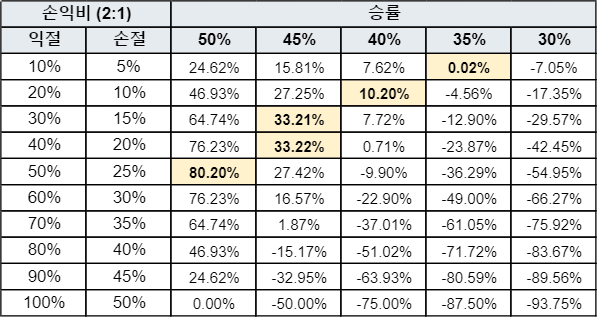
Actually, it's not a big calculation, This is the expected profit rate based on the win rate when trading 10 times, and the formula is as follows.
=(1(1+Profit (%))^(Number of transactions Win rate (%))(1-Stop loss (%))^(Number of transactions(1-Win rate (%)))-1
Why does an optimum exist?
When you don't understand something, it's good to exaggerate it. Let’s say there is an investment expert who boasts a 99% win rate. If you sell only when there is a 200% profit, without a stop loss line, what is the expected profit when trading more than 1,000 times?
The correct answer is 0 won. Since you are a person who experiences 0% with a 1% chance, If you go bankrupt before 1,000 transactions, it will be difficult to recover.
Of course, in reality, it is close to impossible to achieve a 99% win rate. A master who achieves a 99% win rate cannot have a 1% chance of picking a stock that will be closed. Due to the nature of the strategy, trading 1,000 times at a time is close to impossible.
Math is not everything
However, you should not strictly follow the table below to determine the stop-loss line with the highest profit based on your win rate for each period. In reality, there are variables that have nothing to do with one's skills, such as market conditions, physical condition, personal circumstances, and luck. Therefore, not only is it difficult to maintain your batting average every time, There are also cases where trading rules are unintentionally violated, such as when there is a sharp drop.
Besides variables, there are other important aspects. Not only Warren Buffett, but also most investment books mention him repeatedly. “If you suffer a 50% loss, you have to make a 100% profit to break even.”
Therefore, we recommend that you take a more conservative approach than your own win rate and profit/loss ratio. Personally, a 25% stop loss, which is the optimal level based on a 50% win rate, seems like a fairly fatal loss.
What percentage is appropriate?
Unfortunately, the author did not specify the optimal stop loss line. In fact, it is a problem that cannot be specified since each person's skills and goals (profit/loss ratio, etc.) are different.
However, the book often gives an example of a 10% stop loss, Other masters, such as William O'Neill, also suggest a stop loss of approximately 6-10%. It would be a good idea to refer to this and set an appropriate number based on your skills.
In fact, even if you think about it common sense, It is said that Minobini's win rate is approximately 50%. Since we are clearly not mini-binnies, we will be lower than that, A person with a regular win rate in the 30% range, as shown in the table above... It's better not to trade at all. Aiming for approximately 40%, the optimal loss rate at this time is approximately 10%. I think it would be a good idea to set a stop loss line a little conservatively.
What we need to know from this table
Of course, not only can we not determine the future odds of winning, It is impossible to strictly protect the profit and loss ratio. Nevertheless, the truth we must gain from this table is: There is a mathematically advantageous P&L ratio, The point is that we need to use this to make the odds a little more on our side.