outline
At some point, an unfamiliar name caught my eye in the overseas stock purchase rankings. At some point, in terms of individual stocks, the company was in third place after Tesla and Nvidia. A quantum computing company that is captivating just by the word. A company with a predetermined future, just like Tesla and Nvidia. Is IonQ really a company that can change the future as rumored? Or, like countless companies that called for a post-Tesla (Schrödinger, Nicola, Rivian...) Is this a company that is unintentionally investing? Today we are going to learn about IonQ.
**What kind of company is IonQ?**
IonQ was co-founded in 2015 by Dr. Christopher Monroe and Dr. Jeong Sang-jun, and is a company that aims to develop and commercialize quantum computing technology. The founders, Dr. Du, are authors of more than 200 technical papers and are real authorities in the academic world, holding more than 50 patents.
Quantum computing is a technology expected to provide innovative solutions in solving complex problems that are difficult to solve with existing computers, and is expected to be of great help in fields such as research and development of drugs and new materials, weather prediction, and machine learning. In this field, IonQ is a company that develops quantum computer-related cloud services and hardware infrastructure solutions and is one of the leading companies in the field.
How does IonQ make money?
IonQ is already generating sales through quantum computing-related services. There are four major revenue sources: 1) cloud (QCaaS) revenue that provides quantum computing resources to cloud services such as Microsoft, Amazon, and Google, 2) IonQ private cloud revenue, 3) algorithm development, support, and technology origin service revenue, and 4) hardware sales revenue. Management is still in the early stages of the business and is considering a variety of distribution channels, but believes QCaaS will accelerate the adoption of quantum computing.
Brief technical introduction
The field of quantum computers requires knowledge of quantum mechanics and the operating principles of existing semiconductors, not just for a deep understanding but also for a rough understanding. Therefore, I will omit the principles of quantum computing in this article. One of the representative misunderstandings about quantum computing is that it is a technology that creates ultra-high-performance computers that surpass existing semiconductors. The media often introduces quantum computing in a way that says, 'Cryptocracking, which would take hundreds of years with a conventional computer, can be done in a matter of seconds.' This is not wrong. It is true that quantum computing is a technology that will have a tremendous impact on humanity because it has overwhelming performance in calculating the probability of the 'number of cases' such as deciphering passwords.
However, this is thanks to a new calculation method made possible by using the quantum characteristics of entanglement and superposition, not because quantum computing is particularly high-performance. This means that it is no longer a technology that says ‘existing computers will become useless’ or ‘there will be no lag even when playing high-performance AR games.’ For example, in the Joseon Dynasty, the construction of a beacon tower does not eliminate the need for dispatch. Although signal fire is a quick way to convey specific information, it is still necessary to deliver letters directly on horseback to convey detailed communications such as long sentences. Of course, it would be possible to establish detailed rules using beacons. (If you turn on the rightmost beacon for 5 minutes and then turn it off, it's 'ㄱ', if you turn on the third beacon twice for 5 minutes and then turn it off, it's 'A', etc...) However, there is a high probability that it will not be a very fast or accurate method.
For reference, I majored in engineering and have some semiconductor-related knowledge, so I referred to the video below for additional understanding of quantum computing. Not only do I not have a good understanding of quantum computing, but covering the principles of quantum computing in this article does not seem to be very helpful in terms of efficiency or understanding. Watching other videos featuring the same person on the video channel below will help you understand quantum computing in general, and for those who are somewhat interested in science and have a good understanding of quantum, the link to the page below may be helpful.
Understanding Link
Investment point 1. The company that is most properly approaching the technology of quantum computing
In the quantum computing market, there are companies with enormous capital and technological power, such as Google, IBM, and Baidu, but according to Stephen Tobin's Seeking alpha article, IonQ and D-Wave Systems are the only companies that properly utilize entanglement, one of the important quantum characteristics along with overlap, and other companies are said to be mainly using the concept of overlap. Therefore, it is said that it is difficult to expect the rapid performance improvement expected in quantum computing simply by increasing the number of qubits, which are the computational units of a quantum computer.
In fact, unlike other companies that emphasize the number of qubits, IonQ's Proposed the concept of Algorithmic Qubit (hereinafter AQ) indicates algorithm solving ability, and emphasizes that it has superior performance compared to other companies based on AQ. Of course, it may be difficult to trust 100% because it is not a unit recognized by the entire industry, but there appears to be no loophole in the logic of IonQ's proposal of AQ, and given that there is no logical refutation of IonQ's claims, it is believed to be true that it has a technological superiority.
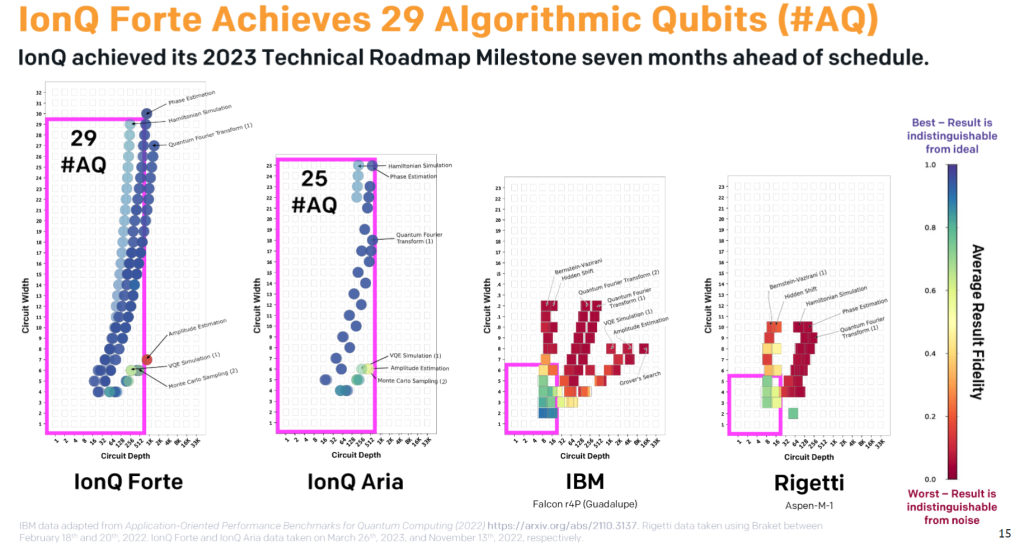 (Source: IonQ Presentation)
In addition to AQ, Google and IBM require extremely low temperatures and huge areas to implement qubits, while IonQ is said to be implemented at room temperature and in a small package as shown in the image below. Of course, it is not a comparison of the same performance, so it is necessary to take this into account, but in any case, the difference in scale drawn by each company can be seen to be significant.
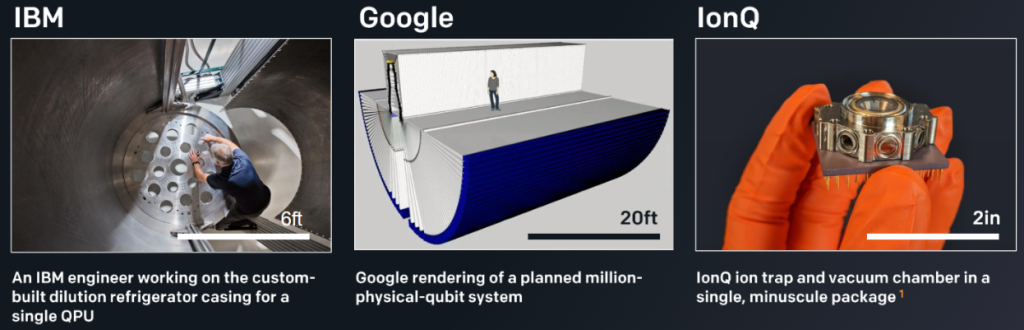 (Source: IonQ Presentation)
Investment point 2. Financial availability
plug power article As mentioned, no matter how powerful and world-changing a technology is, it is useless if you do not have the financial capacity to endure until it is actually implemented and distributed. IonQ's cash assets are approximately $405 million, which is the most stable financial position among pure quantum computing companies. Even assuming current expenses and profits, it is said to have enough cash to last until 2026. IonQ's sales soared nearly five-fold last year alone, and are confirmed to be growing by more than 20% on a quarterly basis this year as well. Of course, as sales are in the early stages, the fluctuations will be severe, and it is not a basis for investing with confidence, but at least it does not seem like we are at a stage where we have to worry about the survival of the company unless something happens within a tight time limit.
(Source: IonQ Presentation)
Investment point 3. Its value is already being proven by cases.
Of course, quantum computers are not cracking cryptography as quickly as rumored, and there is debate about how useful they will be, but this company's products are already being adopted, even if they are insufficient. IonQ currently operates 29AQ machines and is achieving impressive sales and research results. Recent customers include Hyundai Motor Company, Airbus, GE Research, Goldman Sachs, and the U.S. Air Force Research Laboratory.
Looking at the collaboration with Hyundai Motor Company, the future of quantum computers can become more realistic. The contract, signed in January 2022 and extended in December, runs electrochemical metal simulations to explore new battery materials and leverages IonQ's technology to improve object detection used by autonomous vehicles. Both studies are related to number of cases, which derives high probability from countless combinations or situations, and are areas where quantum computers are known to be advantageous in problem solving. Hyundai Motor Company's adoption and contract expansion may be grounds for disproving the usefulness of quantum computers.
Opinions
As this is a company that is talking about tremendous changes in the future, there are naturally opposing opinions. However, at least there seemed to be no opposing opinions pointing out technical shortcomings. Most of the claims were based on misunderstandings of quantum theory. There were theories that the investment was made based on interests, or even opinions denying the existence of a proper quantum computer, but IonQ's research and contract performance alone seemed to be enough to refute it.
However, opinions on fair value seemed painful. IonQ's PSR is a whopping 100 times, making it difficult to view it as a rational investment even considering its quarterly sales performance that continues to grow rapidly.
Financial issues are also something to consider. Although I mentioned it as an investment point earlier, it is only a short-term and very limited perspective. Research costs may increase, the quantum computer market may not grow as quickly as expected, or sales growth may shrink. Moreover, what we must not forget is that this company's competitors are mega-corporations. If there is a competition to attract talent due to the market value of quantum computing, which is greater than expected, will this company be able to withstand it? There are still concerns.
Concluding
It's an interesting company. It appears to have a clear technological advantage over its competitors despite its small scale, and is proving the value of its technology through performance. If there is a quantum computing boom in the market, at least for now, they appear to be the closest company to a post-NVIDIA (which was the biggest beneficiary of the AI boom). However, the still excessively high value and unclear market outlook make people hesitant to purchase this company.
How did Koreans know about this company and eagerly acquire it, ranked 3rd in overseas investment purchases (based on 3 months)? Where did their courage come from? I finish writing today by blaming myself for my laziness. * Of course, this article is not a recommendation to buy or sell.