outline
The stock price of Adobe Inc. (ADBE, hereinafter referred to as Adobe) soared after the recent announcement of second quarter earnings. In this earnings announcement, Adobe showed performance that exceeded market expectations in both sales and profits. Adobe's second quarter revenue increased 11% year over year to $5.31 billion, and EPS increased 11.9%. Meanwhile, the market's reaction seems to be divided depending on the meaning given to Adobe's Firefly performance rather than the performance on the indicators.
Adobe's AI model, Firefly
Adobe officially launched the Firefly service and custom model in September 2023, providing services incorporating AI. Firefly appears to have had a positive impact on its stock price, especially as its second quarter results confirmed that it contributed to the conversion to a paid model.
Firefly is a generative AI that can create images based on text, and is integrated into major programs such as Photoshop and Illustrator to help users create and edit images. Adobe encouraged participation by providing incentives based on the data users uploaded to the stock collection, and also announced that it would provide guarantees and compensation for legal disputes arising from the use of Firefly.
In this way, Adobe is taking very active steps in introducing Firefly, or AI function. It is expected that AI functions will be integrated and expanded across Creative Cloud, Document Cloud, and Experience Cloud, and the surge in stock prices on the 16th appears to reflect this.
Is AI really the signal for a rebound in Adobe’s performance?
In my personal judgment, I have doubts about the question, “Is Adobe’s earnings rebound momentum driven by AI?” Conversational AIs such as ChatGPT and Gemini already show outstanding performance that surpasses that of humans in writing text, but MS Word's status is still solid. No matter how excellent AI is, it is currently difficult to match human tastes and tendencies 100%. Unless AI completely replaces humans, many things still occur between humans, so human intervention such as confirmation and personalization will be required at some stage.
The same goes for image and video creation AI represented by Midjourney and Sora. As images and YouTube shorts are ultimately serviced by people, they ultimately go through human hands, and there is a high probability that Adobe's PhotoShop or Premier Pro will be used in that process.
I'm just saying that ChatGPT is not a competitor
It is clear that the emergence of AI has become a stepping stone for competitors to catch up. One example is Google Docs. Just five years ago, MS Office was one of the essential programs that had to be installed when purchasing a PC. However, at some point, the number of Google Docs users increased, and recently, there has been an atmosphere where people regard it as “MS Office for business use” and “Google Docs for personal use.” This can be said to be an example of excellent use of cloud services.
The same goes for AI. Of course, there are still tools that facilitate various tasks with AI, but most of them are not widely known and have their own inconveniences, such as having to go through several programs, tasks, or steps. Users who are interested in IT will be willing to use new technology even if it is somewhat cumbersome, but most users will wait for the AI update of the existing program (Adobe) and continue their familiar work patterns.
However, what if, as in the case of Google Docs, a product emerges that not only covers most of the scope of use of existing products but also has greater AI usability? From the perspective of Adobe, which has enjoyed an overwhelming position, it is bound to be a threat.
Therefore, Adobe's introduction of AI is not a situation where a huge gap with competitors has been created or a new market is opened, and at least for the time being, it has "secured growth equivalent to TAM." It is evaluated in terms of degree.
Risk factors for performance improvement, Canva
If I had to point out an existential threat to Adobe, it would be Canva. Canva has recently launched an enterprise branding management product and AI-based design tool, aiming to eat into Adobe's market share.
Canva was founded in 2013 and is now a formidable company with 185 million users. Canva is a platform that helps you create visualization materials such as presentations and posters very easily. Adobe's direct competitor is Adobe Express.
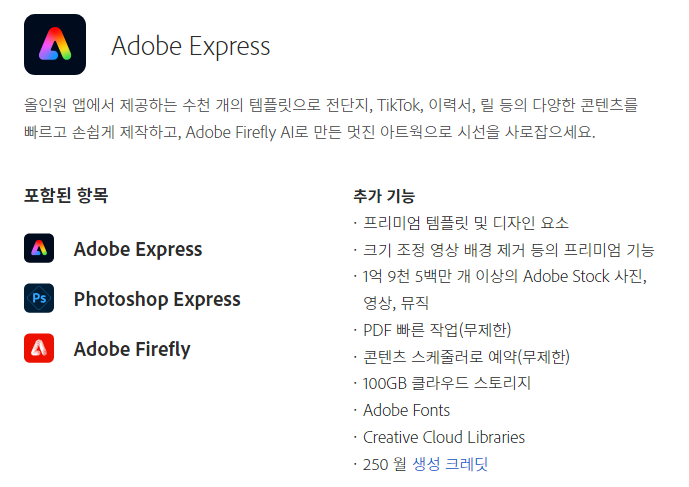 Adobe Express Service (Source: Adobe)
Looking at the two products alone, Canva has a better evaluation. Canva is faster, offers a variety of templates, and offers more features.
Even price competitiveness is ambiguous. Adobe Express is cheaper on a monthly basis, but Canva is cheaper on an annual basis, and Canva uniquely offers a group discount for 3 or more people. (I haven't tried signing up, but seeing as there is a separate business plan, there doesn't seem to be any special restrictions on a three-person setup.) On the other hand, Adobe doesn't seem to have any plans other than student and corporate discounts.
PlanAdobe ExpressCanva ProCanva for groupsTarget IndividualsFor individual teams / 3 or more people Monthly cost 13,200 won 14,000 won 11,000 won / Per person annual cost 132,000 won 129,000 won 110,000 won / Adobe, Canva plan comparison (Source: Adobe, Canva)
Adobe Express is actually a very small part of Adobe, and people who pay for design tools are likely already tied to the Adobe product line. However, depending on the user's level of use, Canva's tools alone can satisfy the user's needs, so it appears that it could pose a significant threat to maintaining Adobe's growth.
Valuation
Adobe's forward PER is around 28, exceeding the sector median of 24 by about 20%. Of course, considering the PER that Adobe has been receiving so far and its still excellent profitability, it is difficult to see it as a burdensome price. However, considering sales growth of around 10%, EPS growth guidance of around 15%, and competitors' growth risks, we believe it is not attractive enough to buy based on the decline.
conclusion
Adobe announced positive results in the second quarter, with both sales and profits exceeding market expectations. However, Canva's continued growth appears to be enough of a threat. As the evaluation of Adobe's Firefly does not seem bad, growth at the TAM level suggested by the company appears to be fully achievable, but the momentum is not believed to be sufficient to recover the high valuation it has received so far.