outline
The past year has been a bitter one for Realty Income investors. Let alone pre-COVID-19 prices, they have fallen more than 20% even from last year's highs, when there were hopes of recovery. A 5% dividend yield is very attractive, but 24 years? There is also news that interest rate increases will stop. Let’s find out whether it is really the right time to invest.
Investment point 1. Undervalued
Realty income fell by more than 20% last year due to concerns about financing costs due to interest rate hikes, which is lower than the five-year average price. Due to the nature of REITs that distribute most of their profits, the P/AFFO ratio, which is used as a valuation indicator instead of PER, is 14.2, which is also lower than the five-year average of 18. Although REITs' borrowing costs are at historic highs due to high interest rates, it is also clear that realty income is undervalued.
A real estate rental company that pays dividends every month and whose profit structure is well known to everyone has a dividend yield of 5%? I wonder if there are any other stocks this attractive.
Investment point 2. Reliable history and performance
The reason the dividend yield of 5% is more attractive is because it is realty income. If you have a lot of concerns about REITs due to concerns about the economy, or if it is difficult to give up the current REITs that provide high dividend income, realty income may be the best choice.
Realty Income is the largest REIT in terms of asset size and has been paying dividends every month since its IPO in 1994. In other words, dividends were paid even during the 2008 financial crisis that shook the world. Despite the 2021 coronavirus issue that made it difficult for many self-employed people, Realty Income's CEO Sumit Roy himself even used the expression "dividends are sacrosanct," solidifying the company's philosophy on dividends.
You may be wondering, ‘Wouldn’t the dividends be consistent and the stock price be boring?’ But that’s not true. The graph below is a comparison graph with S&P, and the average annual return after listing is 14%, and even the drop or volatility during a crisis is less. If I've praised it at this point, I don't think it's necessary to emphasize that Realty Income is the only REIT to receive an A-/A3 credit rating from S&P and Moody's.
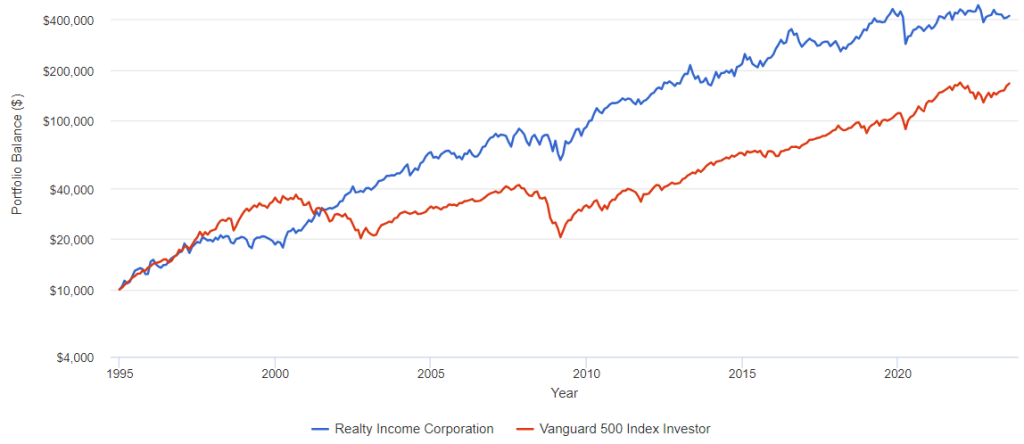 1994.11~2023.08 Comparison of Realty Income vs S&P500 (Written by: PortfolioVisualizer)
As proof of this, Realty Income recently announced a dividend increase for the 103rd consecutive quarter based on its strong performance. The dividend rate was $3.066, a 3.2% increase compared to the same period last year.
Investment point 3. Strong portfolio
How can realty income be so consistent? Realty Income has a strategic portfolio that is spread across various countries and industries and is less affected by changes in the consumption environment.
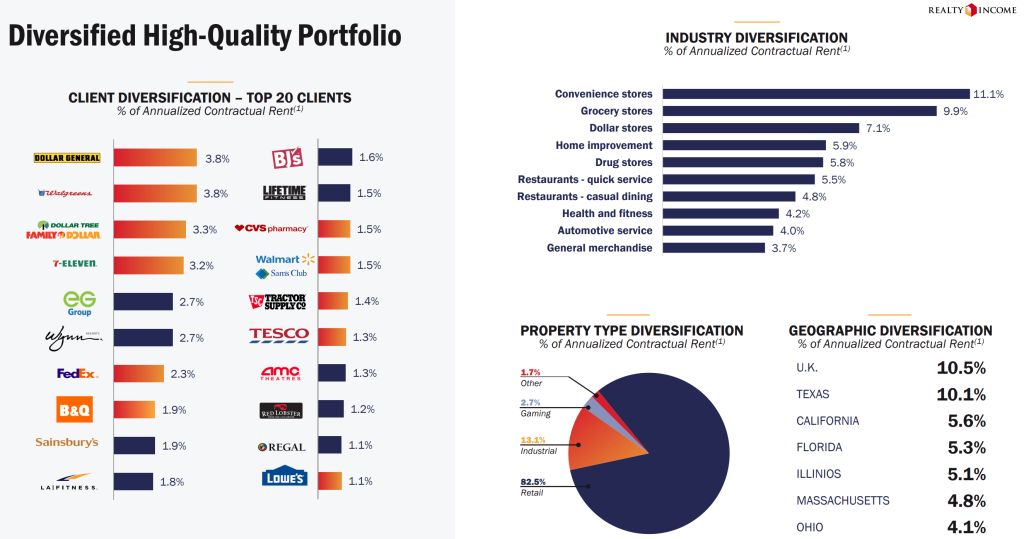 Realty Income Portfolio Composition (Source: Realty Income Presentation, 2023 Q2)
Realty Income currently has 1,303 clients and 13,118 real estate properties across 85 industries. It is also the only US-based REIT with presence in the UK, Ireland, Italy, and Spain. Owning real estate in various countries not only has the effect of hedging risks due to the economic conditions of each country, but also has the advantage of making it easy to take advantage of favorable interest rates depending on the situation. The current benchmark interest rate in the Eurozone is 1.25% lower than in the United States. The tenant composition is also attractive. Realty Income's main customers include dollar stores (Korea's Daiso comes to mind), convenience stores, and pharmacies, and these companies are relatively stable even in recessions and are highly stable despite changes in consumption patterns due to e-commerce such as Amazon.
Lastly, if there is one more advantage of Realty Income, it is that it is a netless REIT, not simply a retail-themed REIT. A net lease is a type of contract in which the lessee is responsible for management fees, taxes, and insurance premiums. Since the contract is usually based on a long-term contract for each building, it is less affected by the economy. In fact, Realty Income's rental rate has never fallen below 96%, and even during the COVID-19 pandemic, the vacancy rate was only 2%.
Investment point 4. Financial structure
Nevertheless, it is clear that the trend of interest rate hikes, with no end in sight, is a cause for concern for REITs companies such as Realty Income. Therefore, rather than blindly cheering the high dividend yield, it is necessary to check whether this crisis can be overcome well.
Realty Income's net debt is 5.3 times its EBITDA, which is good. Moreover, 96% of the debt is unsecured, and 92% is formed at a fixed interest rate with an average maturity of 6.7 years. It also has liquid assets of $3.1 billion. Therefore, like the vacancy rate, it is not expected to be easily affected by a temporary economic downturn or interest rate hike. Rather, Realty Income's strong financial structure can be an opportunity to secure profitable buildings that are being sold due to high interest rates.
Concluding
Of course, Realty Income is not the only answer. Rather, from a value perspective, it is a fairly overvalued REIT. It is not difficult to find companies with lower P/AFFO and higher dividend rates than Realty Income, such as WPC and BNL. Nevertheless, if you want to invest with pivot in mind in a situation where the direction is not yet confirmed and the stock price is continuing to decline, I think you should approach the leading stocks in the most stable sector. There are many reasons why one may not be confident enough to bet on more undervalued stocks.
For a company that has been paying dividends continuously for 27 years despite being a stock that can ride a lot of economic factors, and for a company with a relatively stable financial structure even in unexpectedly bad situations, I think you can feel a little comfortable waiting for the monthly dividend even if the market is somewhat unstable for a while.
>
Related article on REIT investment