outline
If you look at the media or YouTube, it seems like the world is only investing in AI or coins, but the popularity of dividend stocks, especiallyREIT investment, is quiet and steady. It is relatively more familiar than stocks, and dividends that come regularly even if you don't have to pay attention are attractive. You can invest in real estate with a small amount of money, and tedious issues such as tenant management and reinvestment are taken care of.
The most famous among REITs is by far Realty Income (O). The company we will introduce today is NNN REITs, which may be a better choice(?) than Realty Income (O).
Introduction to NNN REITs
To put NNN REITs in one word, it can be said to be a real income with a small market capitalization. Realty Income is worth about $45 billion, and NNN is worth $7.6 billion, a difference of about six times. Portfolio strategies are also similar. Like Realty Income, NNN also has a diversified portfolio focused on small retail rather than relying on large customers. In short, it is a small Realty Income, but nicknames such as Realty Junior are a bit difficult.
Looking at its history alone, it is nowhere near the 55-year-old Realty Income, but NNN is also a 40-year-old company. NNN's record of consecutive dividend increases is actually ahead. While Realty Income has had a record of 29 consecutive years of dividend increases, NNN has a record of 34 consecutive years of dividend increases.
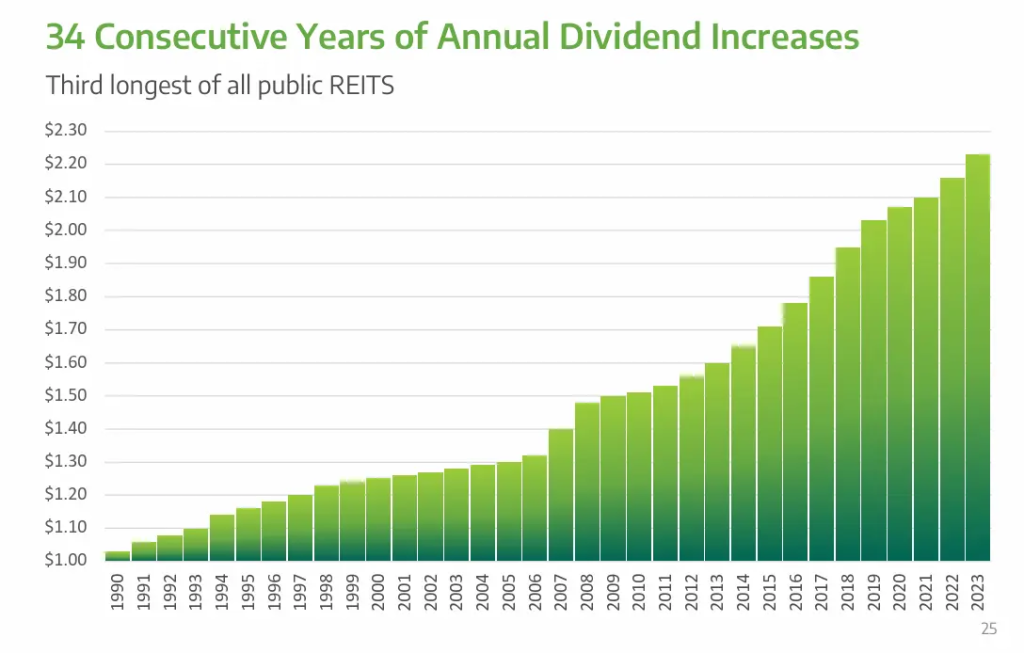 NNN REIT dividend record (Source: NNN reit Presentation)
NNN REITs vs Realty Income Portfolio Comparison
Table 2. Table 3.
The top 10 types of real estate in which the two companies are investing are listed. For convenience, the terminology used by each company was left as is rather than unified. From a broad perspective, the two portfolios don't seem very different in that they both focus on retail. However, if you look more closely at the contract level, Realty Income has a high ratio of large- and high-quality tenants like Walgreens. Accordingly, the lessee's credit rating is higher for Realty Income.
In the case of NNN, which has a high ratio of small and medium-sized tenants, stability may be somewhat reduced, but it is excellent in terms of profitability. Realty Income's average rent increase rate is 2.0%, which is superior to NNN's 1.5%, but it is not meaningful as both are difficult to exceed inflation. In this case, it is important to secure external growth opportunities, and NNN had its third most aggressive year ever, investing $820 million last year. It appears that profitability was improved by selling vacant real estate and purchasing high-quality real estate with a cap rate of 7.6%.
To make an analogy with a bit of exaggeration, it can be seen as similar to Realty Income's investment focusing onstablelarge buildings in central Seoul, and NNN's investment focusing onhighly profitablesmall buildings. Of course, this is an example to help understanding, and it is just an analysis of the differences in style between the two companies, but the two companies are very similar from a large perspective.
NNN REITs? Realty income? Which is the better choice?
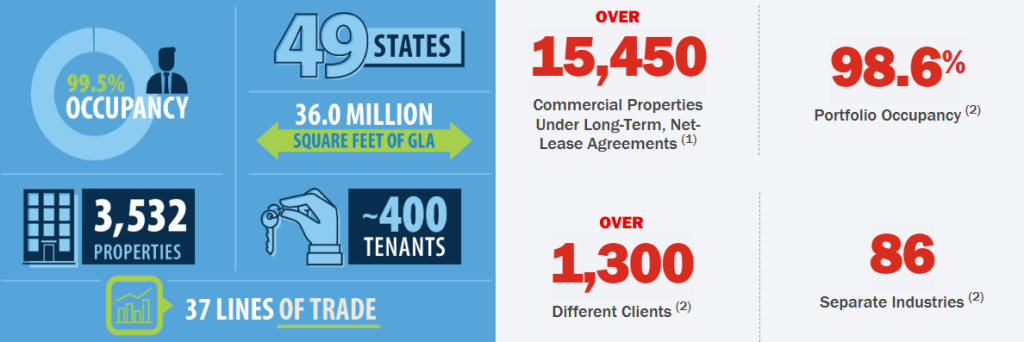 Portfolio Overview (Left) NNN REITs, (Right) Realty Income (Source: NNN REITs, Realty Income)
Since both stocks are companies in the same sector and employ similar strategies (retail REITs), they share many of the investment points and risks. Investment points include a long-term dividend record recognized by everyone, a strong portfolio, and expectations of interest rate cuts, while representative risks include structural changes in profitability due to e-commerce and limited dividend growth potential due to low rent increase rates.
However, assuming you have decided to invest in retail REITs, there are two major things to consider if you are choosing one of the two.
First is stability.
You might say, "Aren't they famous for being stable in terms of financial situation and dividends?", but that's excluding thestock priceaspect. As it is a retail REIT, it may show greater fluctuations than general stocks depending on the real estate market or retail industry issues, and the 2020 coronavirus issue is such a case.
Regardless of financial stability, the two stocks also fell sharply due to concerns across the retail industry, including shutdowns in some regions. Naturally, NNN was hit harder. This is becausethe proportion of small and medium-sized tenants is relatively small.
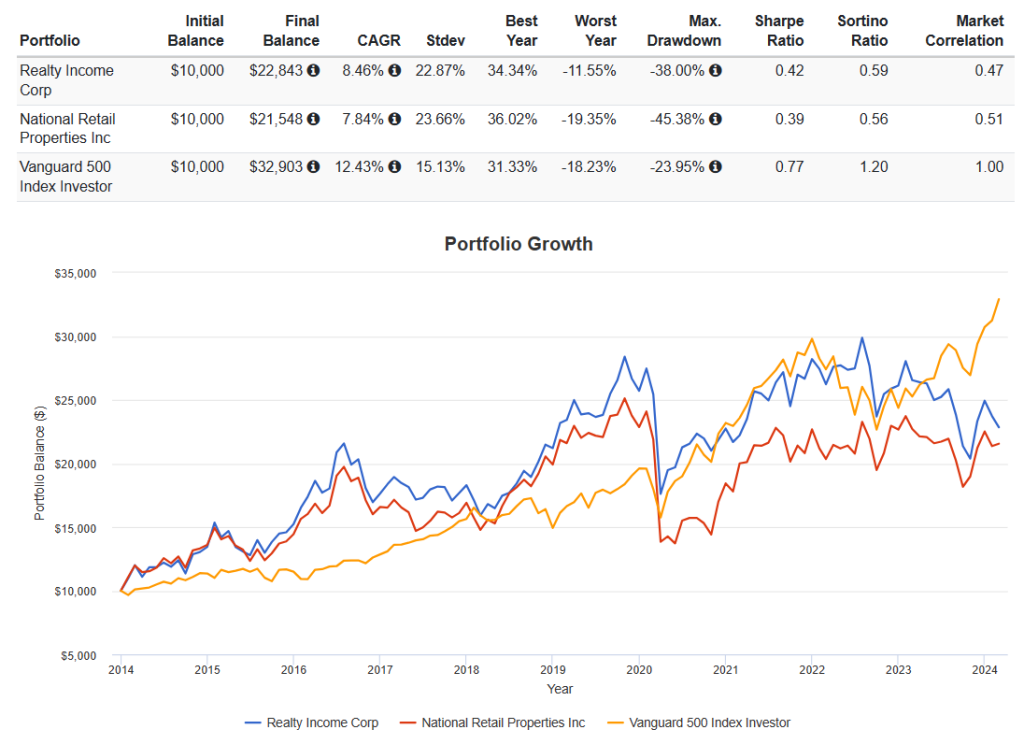 NNN, Realty Income, S&P500 2014-2024 stock price trend and performance (Source: Portfolio Visualizer)
This situation was the same during the 2008 financial crisis. Although it was not a direct retail issue like Corona, small and medium-sized retailers are generally considered vulnerable during a recession.
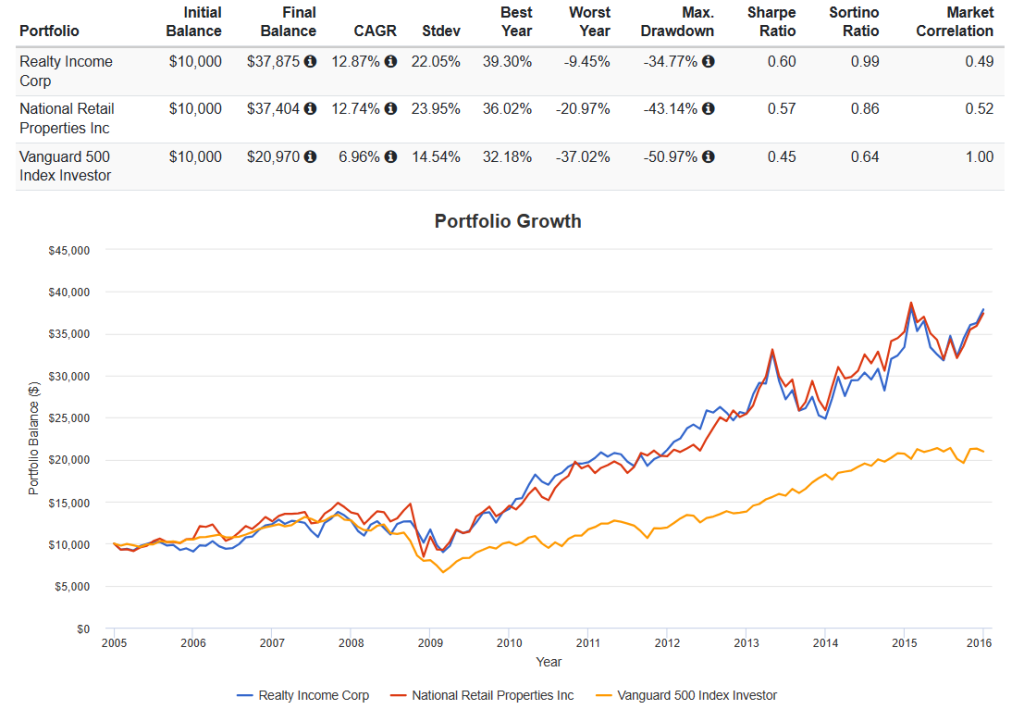 NNN, Realty Income, S&P500 2015-2016 stock price trend and performance (Source: Portfolio Visualizer)
The second thing to consider is valuation.
Realty Income tends to trade at a premium above the sector average thanks to its aggressive external growth, quality assets, and high popularity. On the other hand, in the case of NNN, its management style is evaluated as being more conservative than Realty Income.
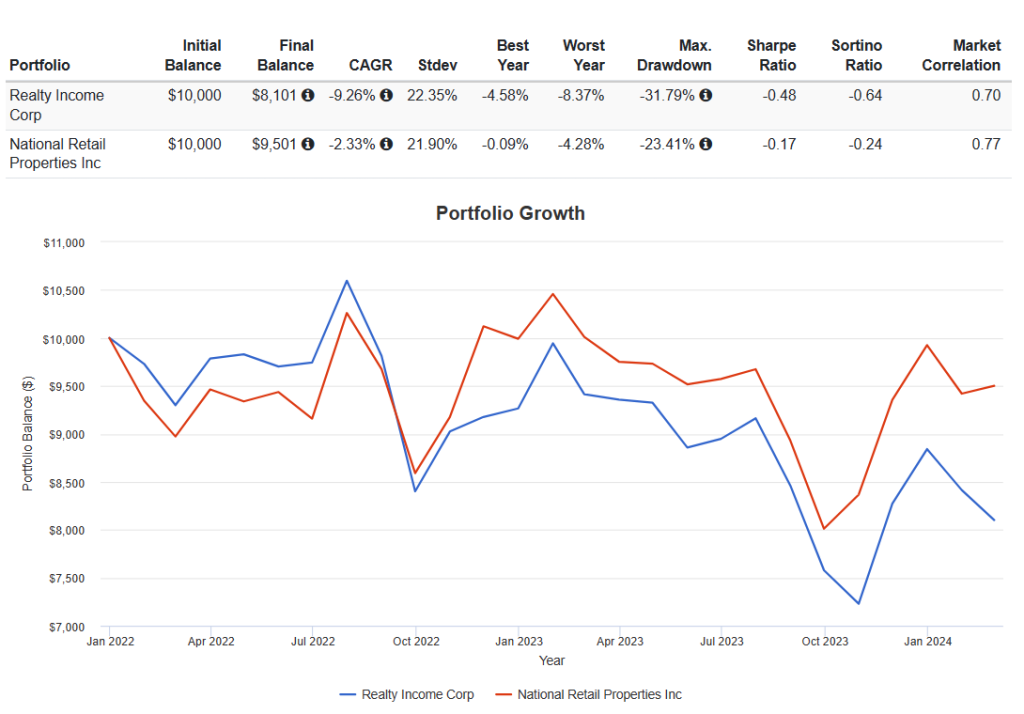 NNN, Realty Income, S&P500 2022-2024 stock price trend and performance (Source: Portfolio Visualizer)
Reflecting this, NNN showed more solid movements in the high interest rate phase. In fact, the financial situation of the two companies showed relatively large fluctuations even though the impact of the interest rate increase was very limited. In particular, Realty Income showed a return of premium as the popularity of REITs decreased due to alternative investments such as bonds due to the interest rate increase.
For reference, looking at NNN alone, the proportion of debt maturing within two years is around 8%, and 15% of total debt is comprised of 2048 or later.
conclusion
As of now, the premiums of the two companies are similar, as the fall due to recent high interest rates has been reflected to some extent. Therefore, in situations where the popularity of REITs is revitalizing, such as through interest rate cuts, there is a possibility that a premium will be placed on Realty Income, thereby compromising the performance of NNN.
NNN REITs Realty Income (O) Sector AverageAverage Dividend Rate (4Y)5.15%4.66%4.44%Dividend Rate (FWD)5.38%5.91%4.77%P / AFFO12.8913.0113.63P / AFFO (FWD)12.5612.5114.50
However, in the long run, as the two companies have shown similar performance, it is advisable to study together and try to make a better choice depending on the situation.