There are stocks that are coming into the spotlight again, showing signs of delayed interest rate cuts. Chevron (CVX, hereafter Chevron) is an essential dividend stock. It tends to be linked to crude oil, a raw material that tends to rise when interest rates are cut, and its strong cash flow and stable dividend, which has been proven through 36 consecutive years of dividends, can be said to be an attractive option in the recent rapidly volatile market. In this article, we learn about Chevron.
About us
Chevron is a global energy company headquartered in the United States, whose main business is exploration, production, refining, and sales of oil and natural gas. The company holds a significant position in the global energy market based on its strong production base in the Permian Basin and Denver-Julesburg (DJ) Basin, and is also actively pursuing high-risk, high-return projects, especially offshore projects.
Chevron recently strengthened its production capabilities in the United States through a merger with PDC Energy, and is expanding its presence in Guyana's Stabroek block through a merger with Hess Corporation. This strategic expansion solidifies Chevron's long-term growth and profitability, and the company remains focused on maximizing shareholder value through continued dividend growth and shareholder return programs.
Investment point 1. Strong Dividend Growth Stocks
If I had to pick just one point that makes Chevron an attractive stock, it would be its consistent dividend income. Chevron's current dividend yield is approximately 4.4%, making it a quarterly dividend stock. For reference, dividend months are February, May, August, and December.
The reason this company is attractive despite not having a very good dividend yield in the era of high interest rates is because it is a Dividend Aristocrat stock that has been increasing dividends for a whopping 36 years. This is why it is included in many dividend ETFs such as SCHD and HDV.
Chevron spends billions of dollars in dividends every year, and paid out approximately $3 billion** in dividends in the first quarter of 2024. Dividend policy like this is evidence that the company is generating stable profits and shows the company's strong will to return to shareholders.
The reason Chevron's dividend can continue to grow is thanks to its high free cash flow (FCF). Chevron continues to generate significant cash flow, and OPEC's production cuts and rising oil prices mean it can expect to secure more cash.
Chevron is active in not only dividends but also share repurchases. Last year, $75 billion share repurchase, equivalent to a whopping 20% of market capitalization was promoted. Chevron's share buybacks are not limited to just last year, and it continues to buy back $10 to $20 billion every year.
Investment point 2. Hess merger
The merger of Chevron (CVX) and Hess Corporation (HES) is a significant decision that strengthens Chevron's global energy portfolio and also includes the acquisition of Hess' Stabroek crude oil field in Guyana.
The merger is worth approximately $53 billion, and Chevron conducted the merger by offering 1.02 shares of Chevron stock to Hess shareholders. Hess shareholders approved the merger in May 2024, and the regulatory approval process is currently underway.
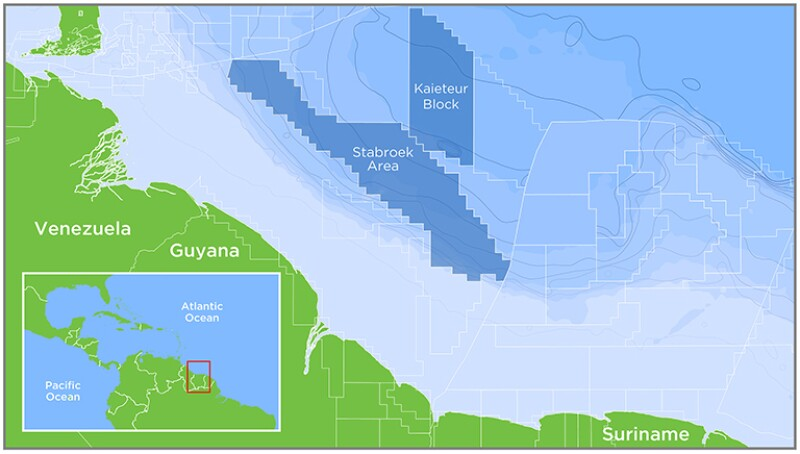 Source : Stabroek Block Bounty Off Guyana Gets Bigger
Guyana's Stabroek block is a large offshore oil and gas deposit and can be viewed as a large oil field with Esso Exploration and Production Guyana, a subsidiary of ExxonMobil, owns 45%, Hess Guyana Exploration owns 30%, and CNOOC Petroleum Guyana owns 25%..
Through this merger, Chevron will acquire Hess's stake, allowing Chevron to significantly expand its global oil production. Guyana's Stabroek block is expected to be capable of producing up to 1.9 million barrels/day of oil in the future, of which Chevron expects to strengthen production by about 570,000 barrels/day.
Investment point 3. Energy demand is not dead yet.
Investing in oil companies in 2024 may be uncomfortable. Even if the electric vehicle market slows down for a while, it is likely that the demand for oil will plummet any moment since it is carbon neutral and eco-friendly energy.
The future that has been decided is probably right. However, it's just not right away.
The energy transition will continue, especially in developed countries, but demand for fossil fuels will increase due to population growth, industrialization, and urbanization, especially in emerging countries.
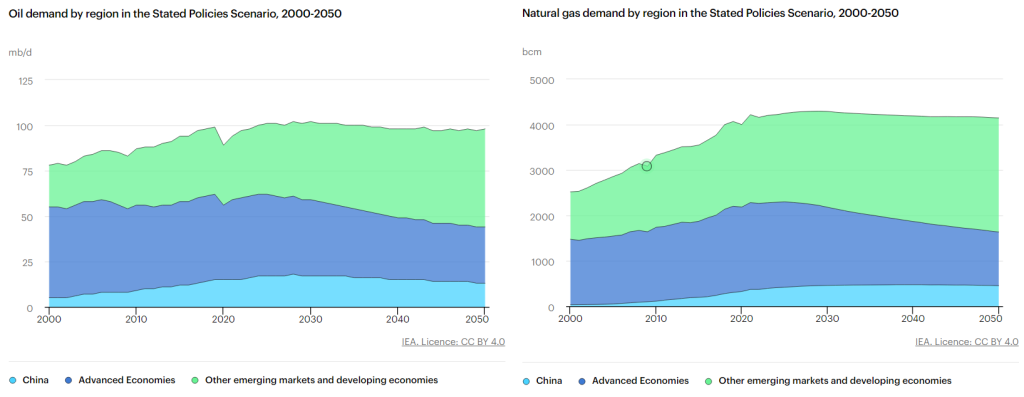 Source : IEA
In addition to oil, demand for natural gas is also expected to remain strong until 2050. Of course, demand for fossil fuels appears to peak before 2030, but solid demand until 2050 appears to be long enough for energy companies to find another source of power.
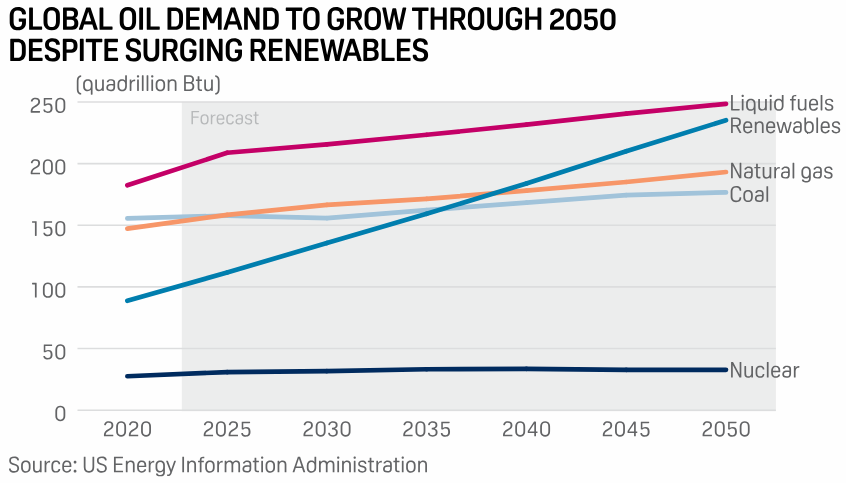 Source : S&P Global
S&P also predicts global energy growth will reach 47%, and it was expected that liquid fuel would still have the highest energy share.
China is actually increasing its coal power plants. is well known, but in fact, China produces two-thirds of the world's renewable energy., making it an overwhelming producer of eco-friendly energy.
If you think about why China increased the number of coal power plants, it is simpler than you think.
This is because renewable energy is not stable. Therefore, even in China, where the proportion of renewable energy reaches 50%, the proportion of coal-fired power generation is very high. This is why humanity’s dependence on fossil energy will continue for a considerable period of time.
Investment point 4. OPEC cuts production
Oil price and Chevron, 1-year and 10-year price change comparison (Source: Seeking Alpha)
We can also expect oil prices to rise due to OPEC's production cuts. : OPEC's decision to reduce production can drive up oil prices, which is a factor that can significantly improve Chevron's profitability and cash flow. If oil prices remain above $60, Chevron's profit model will become more robust, likely leading to additional share buybacks and increased dividends.
This is also good news for investors. Chevron's stock price tends to move in line with oil prices in the short term and slightly exceed them in the long term. OPEC's decision to reduce production is aimed at supporting oversupply and crude oil prices in the market. Therefore, it can be seen as meaning that the downward trend in stock prices will be supported until at least 2025, and stable dividends and stock price increases can also be expected.