outline
Over the past few years, ETF options have proliferated. It is difficult to find various overseas ETFs without leverage. Therefore, selecting a good ETF through the correct ETF investment criteria has become important. In this article, we will present criteria for selecting a good ETF.
Until a few years ago, ETFs were not a major option for investors. Most of them were for investment in domestic sectors, and most of the overseas ETFs that existed did not reflect exchange rate fluctuations. Therefore, when investing in overseas ETFs, the common choice was to invest directly to allow for a variety of options and exchange rate exposure.
However, the ETF market has grown steadily and is now a market worth over KRW 100 trillion, with 829 stocks. (ETN is not included; as of 2/23, the number of ETN listed stocks is 368.)
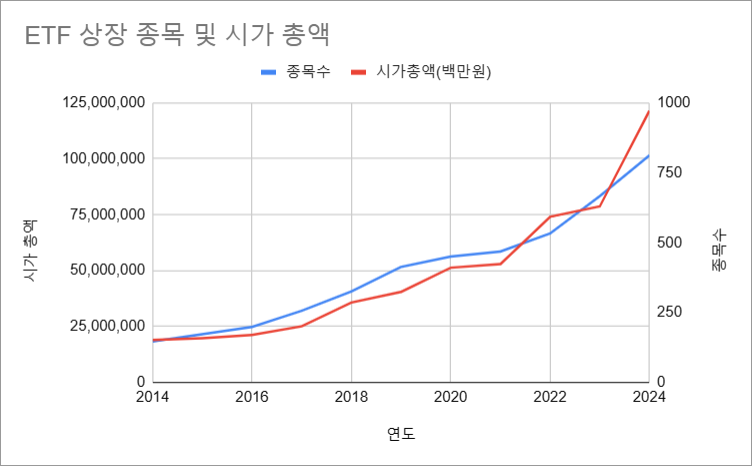 (Data source: Korea Exchange Disclosure Channel (KIND)
Many options, including exchange rate exposure and leverage, that were previously only possible through direct overseas investment are now possible with domestic ETFs. Furthermore, considering the benefits through taxes and ISA accounts, there is no reason to choose direct overseas investment by investing in ETFs.
What criteria should I use to choose?
As there are more choices, so too do concerns. If you are considering investing in ETFs, I will try to point out terms and points you need to know.
Active and passive ETFs
Passive ETFs
The goal is to follow the constituent assets of major indices such as S&P 500, MSCI World, FTSE 100, etc. and operate them similarly to the movements of the indices. This is an ETF that invests according to the composition and investment proportion of each stock when stocks are selected according to certain pre-determined rules (=once the index is calculated). Because it tracks an already established index, fees are lower than active ETFs. The stock name may include the name of the benchmark index or the theme pursued by the index. In some cases, INDEX, etc. are used.
Active ETF
Active ETFs usually have the wordactivein the ETF name. An active ETF is an ETF in which a portfolio manager directly selects and manages various financial products such as stocks and bonds. As experts in the field directly select and replace stocks, you can expect high profits. As such, the fees are relatively high. On the other hand, since it is a job done by people, the performance varies depending on who operates it. In fact, it is known that it is not easy for active ETFs to surpass passive ETFs in terms of ultra-long-term performance.
Exchange rate exposure (overseas ETF)
Currency hedging involves choosing whether or not to reflect changes in exchange rates. The stock name is indicated as(H)or(composite). If there is no indication, it can be considered currency exposure.
As with everything, there is no unconditional advantage for one side. However, in times of global financial crisis, demand for the dollar, a safe asset, has generally tended to soar, so taking these issues into account, it is advantageous not to do currency hedging.
Perhaps reflecting this trend, most of the recently launched ETFs are unhedged. I myself prefer unhedging. However, past results do not guarantee the future. Coincidentally, the recent exchange rate has maintained a high level.
NAV
It is a term that cannot be seen when trading individual stocks, but it is a term that is definitely seen when investing in ETFs. Abbreviation for Net Asset Value, which means net asset value. Since ETF is a concept in which a securities company sells accounts that invest on a specific topic on its behalf, the actual price of the account exists. Therefore, from the investor's perspective, a difference between the net value of the account and the selling price may occur because split unit accounts are exchanged with market participants in real time.
In reality, since the management company participates in trading to prevent the difference between the stock price and NAV from widening, it rarely happens that the difference becomes serious. However, in the case of overseas ETFs, due to overseas market closures, time differences, hedging management methods, etc., there is often a gap of about 2-3%, especially in the simultaneous quote time 10 minutes before the market closes.
Therefore, especially when trading overseas leverage or popular themed ETFs, you should avoid simultaneous quote times as much as possible, and also check the NAV once in a while.
Fees, transaction volume
Of course, ETF operating costs such as commissions are also an important factor to consider. This is because it is a cost that could not have been incurred if individual stocks had been invested. You might be wondering how much of an impact a 0.5% commission would have on investments expecting high returns. If you feel that way, consider taking out a loan. If you are taking out a loan, a difference of 0.5 to 1.0% will be a matter of life and death.
Trading volume is an element that beginners can easily overlook, but should pay attention to.
Although the ETF market is growing rapidly, it is still only 1/20th of the overall KOSPI-KOSDAQ market. There are stocks that seem to be quite popular that invest heavily in American big tech, but have a market capitalization of less than 5 billion. The average daily trading volume of this stock is only 2,500 shares. The closing price of this stock as of February 23 is 12,485 won. What if you burn about 30 million won in this stock with the intention of diversifying your investment in big tech? By paying a price higher than NAV, you can feel like a big player in the market for a moment.
Representative performance indicators, MDD, CAGR, Sharp ratio
It is not easy to gauge the performance of an ETF. To be more specific, this is because the investment value of all stocks held by the ETF must be checked and tracked whenever the stock changes to determine its style and performance. However, the reason for an ETF is simplicity. In this case, it is a good idea to compare the performance of all stocks and compare past performance rather than putting off investing.
Representative examples include CAGR, Sharp Ratio, and MDD above. CAGR(Annualized rate of return) refers to profit, MDD refers to risk aversion ability, and Sharp ratio refers to return compared to risk.. This allows us to compare the past performance of each stock. It is like comparing the report cards of different securities companies on the same theme. Of course, this is only past performance and does not guarantee the future. But usually stocks that are doing well do better.
Unfortunately, it is somewhat difficult to find relevant performance indicators for Korean ETFs. Unfortunately, another way is to find the US-listed version of the ETF you want to invest in and check the relevant information. One way is to compare the 3-, 6-month, and 1-year performance provided by securities companies or portals, and check the decline over the same period through charts. The difference is whether it is a little more strict or not, but the meaning is similar.
In fact, the calculation formula is not that difficult, but if you do not have coding knowledge, it is difficult to secure the stock price data of each ETF.
There are places like this blog that calculate and share these indicators, so when investing in ETFs, you may need to pay attention to these words and search them at least once.
##conclusion
In the end, it is said that 99% of individual investors cannot beat the index performance in the long term. There is no rule not to challenge the 1%, but one way is to ease the burden by investing in comfortable ETFs and run for success in another field.
Additionally, I think that considering the above factors and aiming for excess returns compared to the index would be as valuable to individual investors as studying Warren Buffett's value investing.
Watch also [[Domestic Investment] Comparative analysis of 4 domestically listed REIT ETFs, let’s receive monthly dividends by investing in REITs (monthly dividend ETF)]( https://quokkanews.com/%ea%b5%ad%eb%82%b4%ed%88%ac%ec%9e%90-%ea%b5%ad%eb%82%b4-%ec%83%81%ec%9e%a5-%eb%a6%ac%ec%b8%a0-%ed%88%ac%ec%9e%90%eb%a1%9c-%ec%9b%94%eb%b0%b0%eb%8b%b9-%eb%b0%9b%ec%95%84%eb%b3%b4%ec%9e%90-%eb%a6%ac/ )