Solidigm Is Doing Well, So Why Do SK hynix Shareholders Worry About a Listing?
Seeing the market recognize the value of a good business usually sounds like good news. So why has the possibility of a separate Solidigm listing become unsettling news for SK hynix shareholders? To answer that question, we have to look past how promising Solidigm is and start with the path through which today's hynix shareholders receive the fruits of that growth.
Nor is it easy to write this concern off as investor overreaction. The prospectus SK hynix filed with the U.S. Securities and Exchange Commission (SEC) itself spells out the channels through which a subsidiary listing could work to the disadvantage of parent-company shareholders.[1] A business's growth prospects and the merits of carving that business out into a separate listing are two different questions.

A Risk the Company Itself Wrote Into Its Prospectus
SK hynix's U.S. listing prospectus explains that a subsidiary's initial public offering, additional share issuances, or sales of its holdings could dilute the company's ownership stake. As a result, hynix's claim on the subsidiary's future earnings and cash flows could shrink, and its control over operations and strategy could weaken.[1]
It also contains an explanation tied directly to the share price: the risk that investors may reflect the subsidiary's value directly in separately traded subsidiary shares rather than in hynix stock.[1]
This is a risk disclosure about subsidiary listings in general, not a document announcing specific listing terms for Solidigm. Still, it is an important starting point for understanding why parent-company shareholders are wary of a subsidiary listing. A company succeeding at raising capital and better investment outcomes for the parent's shareholders do not automatically line up.
If Solidigm Is So Attractive, Why Invest Through hynix?
Solidigm began with the acquisition of Intel's NAND and SSD business. In its official statement on October 1, SK hynix said this business centers on high-capacity enterprise SSDs for AI data centers. In other words, the opportunity in AI memory is not limited to HBM.[2]
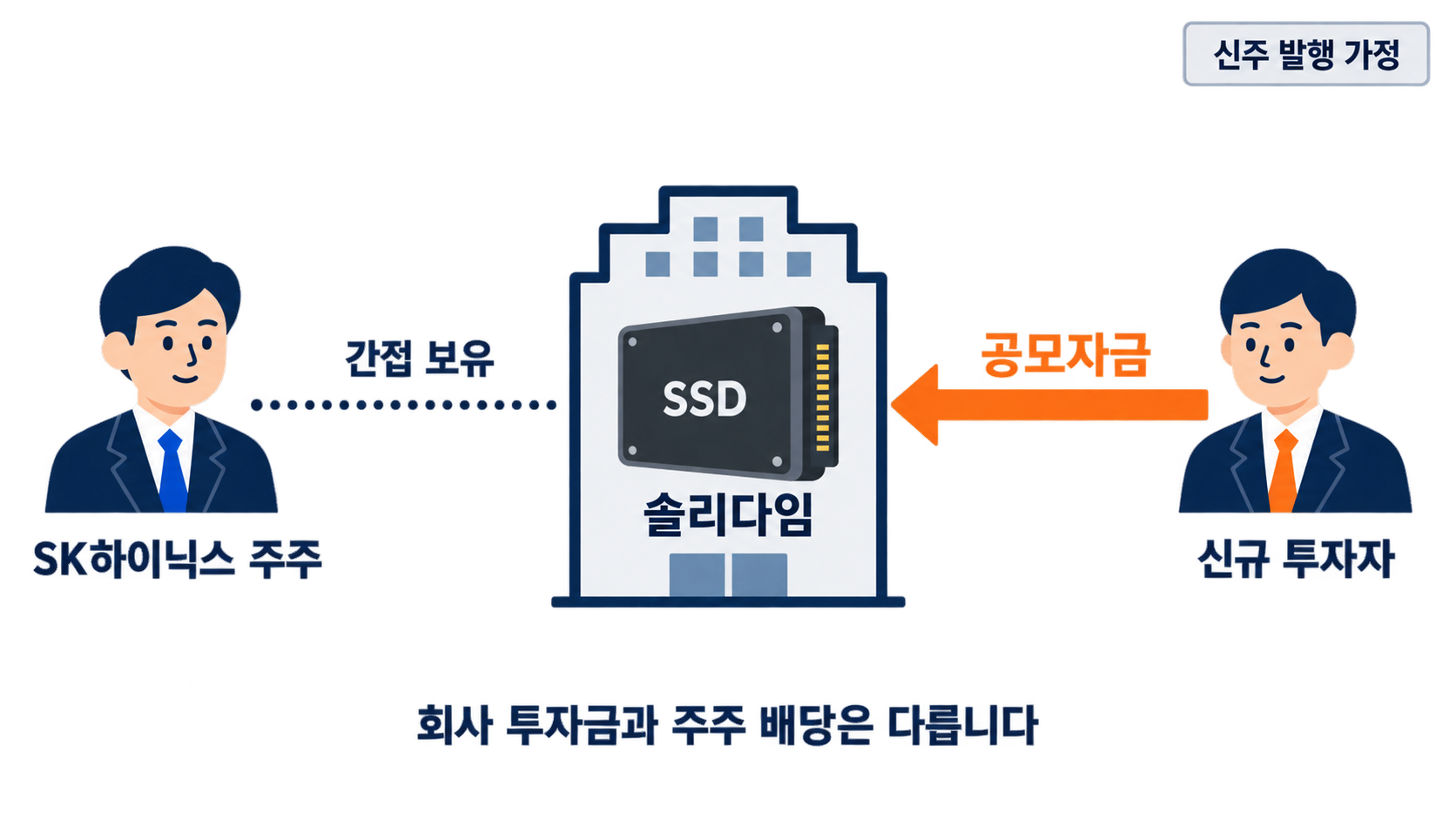
While a business like this sits inside the group, investors can gain exposure to that growth through hynix stock. But if Solidigm becomes a separately listed company, the set of investment options changes: investors who want the AI storage business can buy Solidigm shares directly.
That does not mean hynix's factories or its stake suddenly disappear. What can change is the need to hold hynix stock in order to access that business, and the valuation the market assigns to hynix.
More investors may choose, going forward, to price this growth business in separately listed shares rather than inside the hynix share price as before. This is the familiar concern about a parent-company discount: a gap can open between the value of the stake the parent holds in the subsidiary and the value reflected in the parent's own share price. No one can set the size of that discount in advance, but neither does it follow that simply revealing the value will lift the parent's share price by the same amount.[1]
That is why explaining Solidigm's competitiveness alone cannot calm shareholders. One pillar of the counterargument is that they bought hynix because it was a good business, and now a different stock is emerging that lets them invest in that business directly.
Consolidated Results May Stay Big, but My Share Can Change
Another issue is where the earnings end up. Even if a subsidiary lists separately, as long as the parent keeps control, its results can continue to be included in the consolidated financial statements. But once outside shareholders exist, net profit has to be split between owners of the parent and non-controlling interests.[4]
So the mere fact that consolidated revenue or consolidated operating profit keeps showing up does not mean existing hynix shareholders' economic share is unchanged. What investors deserve to hear about is not just the size of the consolidated numbers, but the earnings and cash flows attributable to hynix shareholders after the transaction.
That said, it is also wrong to convert a lower ownership percentage straight into a proportional loss of wealth. If new shares are issued at a fair price, cash comes into the company in exchange. Existing shareholders' percentage may shrink even as the assets and business capacity of what they own grow.
What shareholders must probe comes next. Will the new money generate returns large enough to compensate for the dilution? When will those returns materialize? Who bears the burden if the investment fails or more funding is needed? Dilution is not always a loss, but the company has to prove why shareholders should accept it.
Where the Offering Proceeds Land and Where Shareholders Get Paid Are Not the Same Place
New-share issuance and secondary sales of existing shares also need to be read separately.
If Solidigm issues new shares, the offering proceeds go to Solidigm. They can be invested in production capacity and R&D, but that money does not instantly become dividends for hynix shareholders. Until the expected investment results arrive, existing shareholders shoulder the risk and the wait together.
By contrast, in a secondary offering that sells existing holdings, the proceeds go to the entity that actually sold the shares. If the holder is an intermediate entity, the path by which that cash reaches hynix and then flows on to hynix shareholders has to be verified separately. Securing sale proceeds and returning capital to shareholders are not the same event.
Skip that distinction and tout only the size of the offering, and it becomes easy to confuse money coming into the group with money coming back to shareholders of the company you invested in. What shareholders need is not marketing of the offering size, but an explanation of where the money lands, what it will be used for, and the path by which it is returned.
Where Will the Profits They Earned Together End Up?
A separate listing raises questions about decision-making as well as ownership percentages. When two listed companies with different shareholder bases run interconnected businesses, the interests at stake in the same transaction can diverge.
Consider semiconductor materials or technology being traded between affiliates. Lower the supply price and the buying company's profit grows while the selling company's profit shrinks. For a shareholder whose economic interests in the two companies are not identical, which side keeps the profit starts to matter. This is an example of the kind of conflict of interest that can arise in related-party transactions; it is not a claim that unfair price transfers have already occurred between Solidigm and hynix.
SK hynix's prospectus also treats the terms of transactions with affiliates and related parties, and the associated risks, as a separate topic.[1] So after a listing, how the terms of investments, technology royalties, financial support, and dividends will be explained to each company's shareholders matters as well.
Widen the lens, and group financing must also be distinguished from the interests of hynix's ordinary shareholders. Even an arrangement that makes it easier for the group to secure outside capital while keeping control is not automatically the choice most favorable to hynix shareholders; that is a separate question. The task is not to declare that benefits have actually been transferred to a particular shareholder, but to publicly verify who bears the funding burden and who holds which rights.
How Far Does the “Securing Investment Funding” Counterargument Really Go?
The case is not all one-sided. Bloomberg Intelligence analysis reported by Yonhap News noted that if Solidigm raises outside capital directly, it could lighten hynix's investment burden and widen its room to allocate capital to other businesses such as HBM. The same report also carried Korean analysts' concerns about duplicate listings and damage to shareholder value. There is no need to read this as a unanimous expert view.[3]
In its October 1 statement, the company likewise said that even with a solid balance sheet, funding every investment internally is not necessarily optimal, and that it will compare the economic impact on existing shareholders of using internal funds versus external capital.[2]
In the capital-intensive semiconductor business, that is a logic worth examining. But an explanation that you need money to invest does not carry you all the way to the conclusion that a separate listing is best. The company has to show why the deal favors existing shareholders compared with alternatives such as its own cash, borrowing, or capital raising at the parent level.
The benchmark should not stop at the option of not listing and not investing at all. It must also be compared against pursuing the same growth opportunity with a different funding structure. Only by checking how much financing cost and financial burden are reduced, how large an economic share is ceded to outside shareholders in exchange, and what returns the additional investment generates can a judgment finally be made from a shareholder's perspective.
Questions the Board Must Answer First
What I want to pin down in this matter is less a grand headline valuation for the listing than the concrete terms of the deal.
First, why should the money be raised at Solidigm rather than at hynix? The pros and cons versus other funding routes have to be explained from the standpoint of existing hynix shareholders.
Second, whose stakes change, and at what price? Pre-listing investments and the main offering should be examined separately, along with the mix of new and existing shares and the effective economic ownership after the transaction. Raising a large sum and receiving a fair price are two different things.
Third, where does the money—raised directly or secured through stake sales—actually go? Business investment plans and expected returns, cash transfers to the parent, and shareholder return plans each need to be presented separately. A special dividend that has not been announced should not be added to expected returns in advance.
Fourth, when the two companies' interests collide, what standard decides? If only group-wide growth is emphasized, with no mechanism for scrutinizing related-party transactions and the allocation of investment opportunities, it is only natural for ordinary shareholders to stay on guard against discount risk.
Saying the company will keep control after the listing does not settle these questions. Control and the economic benefits that come back to ordinary shareholders are not the same concept.
Conclusion
The core of the Solidigm listing worry is not that the company's business is bad. Precisely because it is an important growth business, existing hynix shareholders cannot help being sensitive to any change in the share of that growth they receive and in how the market prices it.
The reference date for this post is October 22, 2026. The company's official October 1 statement reviewed here says no specific plan for deploying capital has been decided.[2] This post therefore does not assert that a listing is confirmed or that any particular dilution or share-price decline is bound to occur. But the economic questions shareholders are worried about do not become lighter just because the terms are undetermined.
Separately listing a good business still has to be proven, on its own, to be a good deal for the parent's shareholders who already own a piece of that business. Before talking up Solidigm's high valuation, the company should explain how this choice grows hynix shareholders' share of the pie more than other funding options would. That, in my view, is the question the company and its board must answer first in this debate.
References
[1] SK hynix, U.S. listing prospectus, Form 424(b)(4), Risk Factors — risks around subsidiary IPOs, stake sales, and related-party transactions, printed pages 36–37 [2] SK hynix, Clarification Regarding Recent Media Reports on Solidigm, 2026-10-01 [3] Yonhap News, “Shareholder Sighs Grow as Solidigm Listing Debate Drags On… BI: Effect of Securing Investment Funding,” 2026-10-18 — a report of expert opinions, distinct from the company's confirmed plans [4] IFRS Foundation, IFRS 10 (2026 issued), provisions on consolidation procedures, non-controlling interests, and loss of control
Disclaimer: This post is informational content summarizing filings, analysis, and the author's views; it is not a recommendation to buy or sell any particular stock.