If AI can handle customer service and assist with sales, will businesses keep paying subscriptions for their existing software? Much of the anxiety surrounding Salesforce comes down to that question. Yet Salesforce’s answer has been not to shrink its business, but to buy another company that helps businesses communicate with customers.

On October 20, 2026, Salesforce announced an agreement to acquire Braze at an enterprise value of approximately $5.66 billion. Braze common shareholders are to receive $47.50 per share in cash. The acquisition has not closed. Subject to approvals from Braze shareholders and regulators, among other conditions, it is expected to close in Salesforce’s fiscal 2028, which runs from February 2027 through January 2028.[1]
Buying a business that matters in the AI era sounds reasonable. But Salesforce shareholders have another question to answer. Adding a good business and buying that business at a good price are not the same thing.
Salesforce is not just buying the ability to write advertising copy
Salesforce grew through customer relationship management software, usually called CRM. It helps businesses track transactions with customers, the progress of sales opportunities, and incoming service requests.
Braze sits closer to the actual communication with those customers. Its platform connects email, text messages, app notifications, and other channels, helping businesses decide what message to send and when, based on customer behavior. Salesforce’s proposed combination would connect existing customer information and Data 360 data with Agentforce’s decision-making and Braze’s real-time customer touchpoints.[1][2]
Imagine a customer putting an item in a shopping cart and then abandoning the purchase. It may seem that an AI system capable of writing a good message can handle the rest. In practice, business operations are more complicated. The company needs to establish whom it is permitted to contact, exclude people who have already purchased, send the message through the appropriate channel, and record the result. Generating a message and executing a customer workflow are different jobs.
Seen this way, the strategic direction makes sense. Even if AI replaces parts of a software interface, it does not follow that the systems connecting business data, permissions, and actual operations will disappear at once.
However, Salesforce already has marketing software. This is less about buying a capability it has never had than adding stronger mobile and real-time customer engagement to its existing products. The company therefore needs to show what becomes better after integration. A longer list of features does not automatically make customers spend more.
Does adding a growing company solve the growth problem?
Braze’s growth stands out. Revenue for the quarter ended July 31, 2026 was approximately $227.2 million, up 26.2% from a year earlier. It had 2,789 customers and a dollar-based net retention rate of 110%, a measure of how recurring revenue from an existing customer cohort is maintained and expanded. It reflects expansion, contraction, and attrition within that cohort while excluding new customers.[4]
Salesforce’s revenue for the same quarter was $11.345 billion, up approximately 11%. That included $456 million of revenue from the acquired Informatica business. This is why one headline growth rate should not be read as evidence that every part of the existing business is improving at the same pace.[3]
The same distinction will matter after Braze is added. An increase in consolidated revenue will be relatively easy to observe. Whether existing Salesforce customers buy Braze as an additional product, and whether using the two together improves contract retention, are separate achievements.
Comparing their sizes also helps set expectations. The midpoint of Braze’s fiscal 2027 revenue guidance is approximately $911.5 million. That is about 2% of the $46.25 billion midpoint of Salesforce’s revenue guidance for the same fiscal year. This comparison puts the businesses’ relative scale in perspective; it is not a forecast of Braze’s revenue contribution after the acquisition.[3][4]
Salesforce is buying a growing asset. But Braze is small relative to Salesforce, making it difficult to expect Braze alone to solve the much larger company’s growth problem. Ultimately, customer expansion beyond the simple addition of the two businesses will matter.
Is $5.66 billion a low price?
After an acquisition announcement, it is easy to focus on the target’s growth rate. Shareholders of the buyer need to look at the price tag as well.
The following is the fiscal 2027 guidance Braze issued in September 2026. That fiscal year ends in January 2027.[4]
| Metric | Company guidance |
|---|---|
| Annual revenue | $910 million–$913 million |
| Annual adjusted operating income | $75.5 million–$76.5 million |
Dividing the announced enterprise value of $5.66 billion by the midpoint of each range gives approximately 6.2 times revenue and 74.5 times adjusted operating income. The latter is not a price-to-earnings ratio: it is enterprise value divided by adjusted operating income. These multiples put the price in perspective using the current guidance, before future growth and the effects of integration.[1][4]
It would be too simple to declare that six times revenue is necessarily expensive for a company growing at 26%. Equally, a plausible revenue multiple does not mean that its earnings were acquired cheaply. To justify this price, the business needs not only higher revenue, but also a substantial increase in the profit that revenue produces.
Enterprise value must also be distinguished from the actual payment for the shares. The $5.66 billion is the transaction size announced on an enterprise-value basis. It should not be treated as exactly the same figure as the cash Salesforce will spend buying the shares. The agreed cash payment per share and the valuation basis used for the overall transaction are different pieces of information.[1]
Should existing shareholders feel comfortable because the deal is in cash?
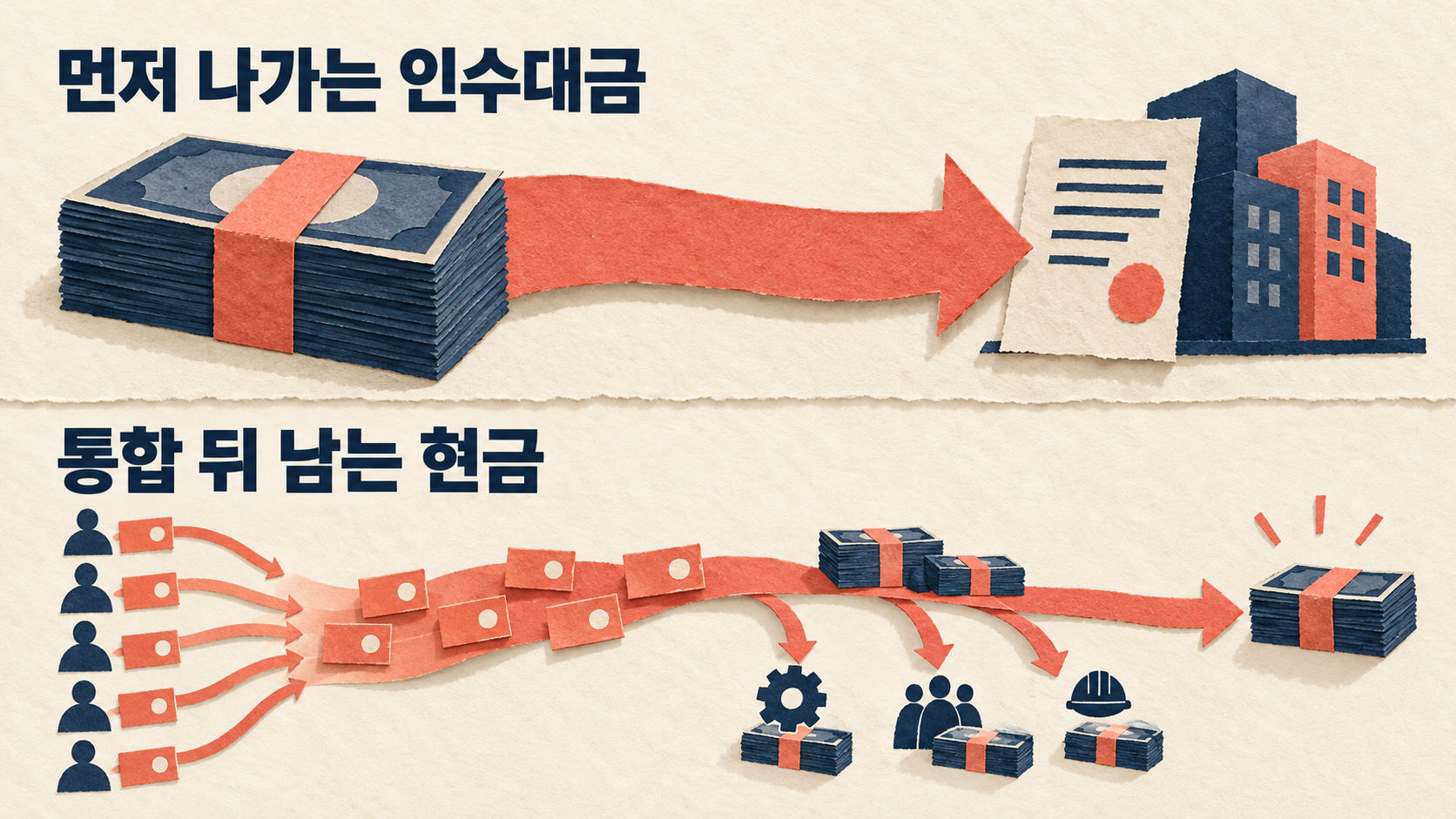
A cash acquisition has a clear advantage. Unlike a transaction paid for by issuing new shares, the acquisition consideration itself does not directly reduce existing shareholders’ ownership percentages. Salesforce also emphasized cash funding and a non-dilutive form of consideration in its investor presentation.[2]
But an unchanged ownership percentage does not eliminate the economic burden. Spending cash reduces liquidity; using debt creates interest expense. Shareholders also need to compare the alternatives, such as reducing debt or repurchasing shares with that money. The public materials did not specify how much of this transaction would be funded with existing cash versus new borrowing.
Nor is Salesforce starting from a debt-free position. At the end of July 2026, it had approximately $11.4 billion of cash and marketable securities and $39.3 billion of debt. Its cash-flow statement recorded approximately $27.3 billion of share repurchases during the first half of that year. Quarterly interest expense rose from $67 million a year earlier to $473 million. All of these figures predate the announcement of the Braze acquisition.[3]
These figures alone do not mean that Salesforce cannot afford Braze. But the context matters: a company already making large capital-allocation decisions has chosen another cash acquisition. Whether the money goes toward buybacks or acquisitions, the resulting value per share needs to exceed the money committed for the decision to be a good one.
In particular, the acquisition presentation explains that a contribution to revenue growth is balanced by pressure on near-term profitability. Avoiding ownership dilution through cash consideration and experiencing earnings dilution shortly after an acquisition can coexist. Shareholders should not assume that profits will improve immediately upon acquisition.[2]
Profitability is improving, but the costs have not disappeared
Braze’s profitability has recently improved. For the quarter ended July, adjusted operating income was $22 million, and free cash flow under the company’s definition was positive at $21.7 million. This does not mean that it has already become a highly profitable business. Under generally accepted accounting principles, or GAAP, it reported an operating loss of $18.1 million for the same quarter.[4]
Stock-based compensation is an important item behind the difference between those profit measures. It was $35.7 million for the quarter. Adjusted earnings exclude items such as this, but compensation needed to retain employees is not economically free.[4]
Stock-based compensation does not require an immediate cash payment of the same amount. Mechanically subtracting it from free cash flow and presenting the result as the official cash-flow measure would therefore also be wrong. Nevertheless, retaining key employees after the acquisition will require compensation in some form. It is difficult to assume that earnings calculated before the acquisition by excluding stock-based compensation will flow through unchanged to Salesforce shareholders afterward.
AI usage raises a similar issue. Greater use of AI features may demonstrate demand for the product, but the models and infrastructure serving that usage also cost money. Without examining actual customer revenue alongside the cost of providing the service, growth in workload cannot simply be read as growth in profit. This is also an important point of disagreement between bullish and bearish views of Salesforce.[5][6]
Customers need easier connections, and shareholders need something left over
It is relatively clear what a successful acquisition would look like. Businesses would spend less effort moving data between systems and could send more appropriate messages based on the same customer information. Salesforce could sell a broader set of products to existing customers, while Braze could use Salesforce’s distribution network. The synergies the company expects point in this direction.[1][2]
The question is whether customers will actually pay more for the combination. If they simply replace an existing product with Braze, some of the new revenue may substitute for other revenue. Rationalizing overlapping functions could also distract development and sales teams. Customers using Braze alongside external systems still need to be satisfied. Owning products together and offering customers a better package are different things.
After the transaction, I would therefore watch three things together rather than a single revenue growth rate: whether existing customers’ additional purchases and contract retention improve; whether profitability improves after integration costs and employee compensation; and whether those results translate into greater cash generation per Salesforce share.
There is still time before the expected closing window, and neither a specific synergy amount nor a target post-acquisition profitability level for Braze has been disclosed. There is no need to fill every blank with an optimistic number. If this is a good transaction, evidence should emerge in customer usage and actual cash generation over time.
Conclusion
Salesforce’s acquisition of Braze is one answer to the question of whether enterprise software can retain value in the AI era. There is a persuasive strategic logic to moving beyond holding customer information and connecting it with the execution of real actions.
But choosing a company that can survive the AI era is different from judging whether that company is spending money wisely in the name of AI. Buying a rapidly growing business does not, by itself, increase Salesforce shareholders’ share of the value. The business needs to generate cash beyond the purchase price, integration costs, and ongoing employee compensation.
What I want to see from this transaction is not a longer product list. It is customers’ work actually becoming simpler, while more money is left for Salesforce shareholders. When those two outcomes are demonstrated together, the assessment can move from a good strategy to good capital allocation.
References
1. Salesforce announces agreement to acquire Braze — October 20, 2026 2. Salesforce acquisition investor presentation — SEC Form 8-K, Exhibit 99.2 3. Salesforce fiscal 2027 second-quarter results and financial statements — quarter ended July 31, 2026 4. Braze fiscal 2027 second-quarter results and outlook — released September 8, 2026 5. Gary Alexander, a bullish view of the acquisition’s product fit — Seeking Alpha, October 21, 2026 6. Andres Veurink, a counterargument on AI usage and unit economics — Seeking Alpha, September 23, 2026 7. Donovan Jones, earlier criticism of Braze’s profitability and stock-based compensation — Seeking Alpha, March 6, 2026
Disclaimer: This article provides information based on public disclosures, analysis, and the author’s views. It is not a recommendation to buy or sell any particular security.