When you look at the money Meta plans to spend on AI, the first thought that comes to mind is this: isn't a company that was making good money selling ads on Facebook and Instagram getting too deep into an AI race whose profitability hasn't yet been proven? The argument that it needs to build bigger data centers than its competitors sounds plausible, but shareholders ultimately care about something else—whether the money left over for them is also growing.

Yet value investors have been buying this company too. Bill Ackman's Pershing Square increased its existing Meta stake, and Oakmark's value funds added it as a new position. This is not a call to buy alongside them. Still, it's worth noting that perspectives on the AI investment race don't simply split into optimism and pessimism.
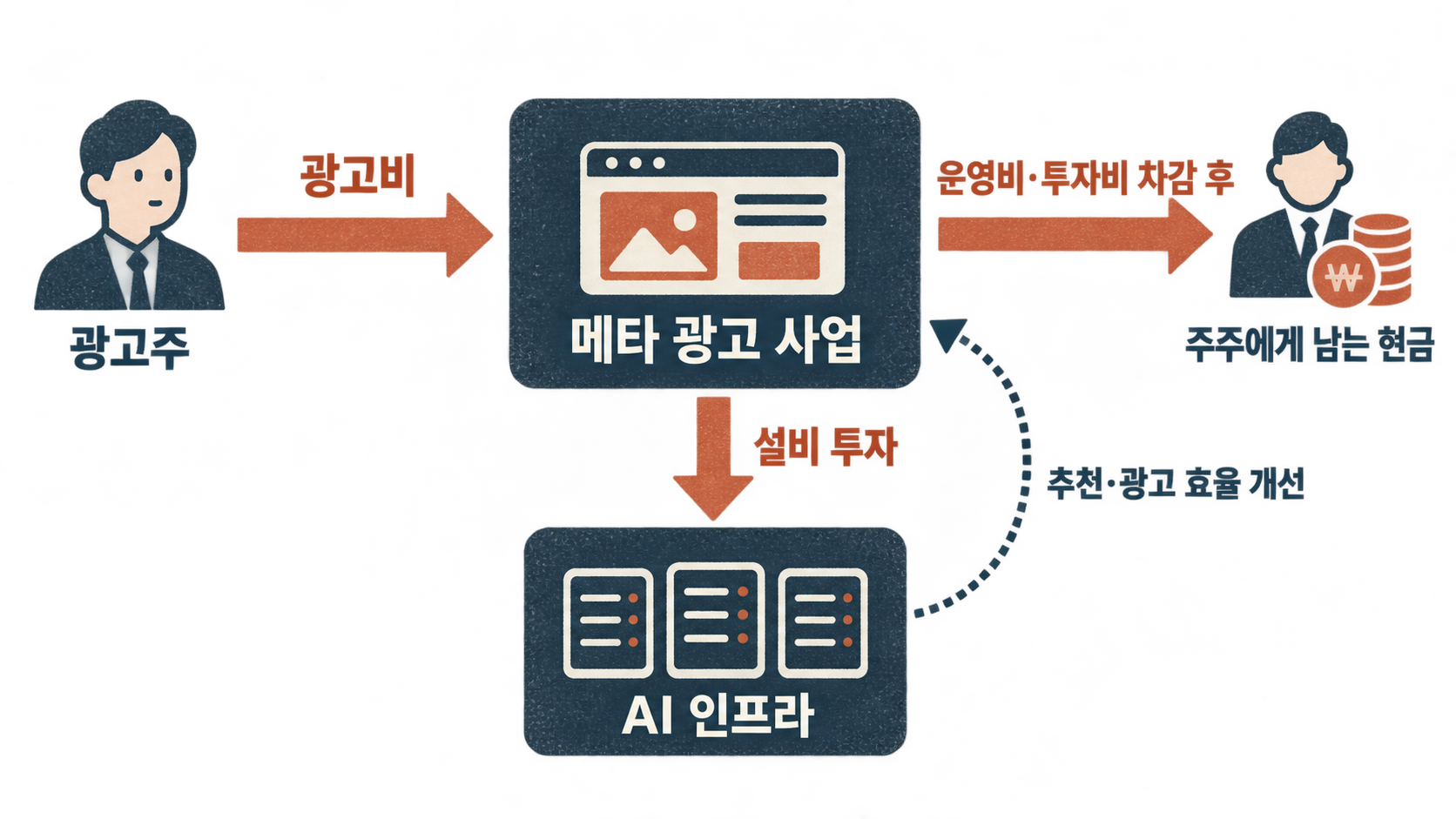
The reason Meta's AI spending might be fine isn't purely the hope of striking it rich selling AI services in the distant future. It's closer to a structure of improving the efficiency of an already profitable advertising business and converting that improvement into revenue. Of course, the fact that ads sell well and the judgment that the scale of investment is appropriate are two separate things.
Ackman Bought More; Oakmark Bought for the First Time
First, we need to be precise about what "bought more" in the title means. In Pershing Square-affiliated 13F filings, Meta shares held rose from 2,660,861 at the end of March 2026 to 3,196,062 at the end of June. That's an increase of 535,201 shares, or about 20.1%—a case of adding to an existing position.[1]
By contrast, the Oakmark Equity and Income Fund's third-quarter letter classifies Meta as a "new purchase." As of the end of September, it accounted for 1.4% of the fund's net assets. Since that's smaller than the fund's 2.6% Salesforce position in the same document, it's more natural to see this as a choice reflecting a new investment thesis in the portfolio rather than an overwhelming conviction betting the entire fund.[2]
We should also distinguish timing from reasoning. The increase in holdings as of the end of June was not a judgment made after seeing the October earnings. A 13F shows holdings at quarter-end; it is not a trade record that tells you the actual purchase dates or prices.
So what were they looking at? Pershing Square's 2026 interim report focuses on a structure in which better content recommendations increase user engagement and more sophisticated ad targeting improves monetization. Oakmark also cites improving the existing business through AI infrastructure as its reason for investing. In other words, this is not purely a bet on guessing at a market that doesn't yet exist.[2][3]
You Can Make Money With AI Without Charging for AI
At its core, Meta is a company that connects advertisers with users. Users view content and communicate with people. Advertisers pay to show ads, during that process, to people who are likely to buy their products.
When AI enters this picture, two paths to making money open up. One is doing a better job of finding the content users want to see. If recommendations in Feed and Reels improve, users are more likely to use the services more often and for longer. That increases the opportunities to show ads.
The other is increasing the value of each individual ad. From an advertiser's perspective, showing a sneaker ad to someone looking to buy sneakers is a different product than blindly repeating the same ad to someone who isn't interested. If the same budget generates more purchases or inquiries, the advertiser has a reason to keep budget on that medium, and Meta gains room to translate better ad efficiency into revenue.
The strength of this structure is that Meta doesn't need to sell AI subscriptions to all of its users. Recommendation quality can improve even if users never notice the AI, and ad performance can improve even if advertisers don't separately purchase a new AI service. AI becomes not an independent new business but a tool that makes the existing business run better.
Of course, better recommendations don't always mean more money. Too many ads can drive users away, and stronger personalization increases regulatory burdens around privacy and youth protection. The constraint that efficiency improvements must not conflict with the user experience remains.
Ad Growth Is Already Showing Results
In the third-quarter results announced on October 21, 2026, Meta's revenue was about $64.6 billion, up 26% year over year. Over the same period, ad impressions across the app family grew 10%, and the average price per ad rose 14%.[4]
Showing more ads and charging more per ad worked together. Simply multiplying the two growth rates gives a growth factor of about 25.4%. It's not a formula that exactly matches the actual ad revenue growth rate, but it helps in understanding where the revenue growth came from.
In these results, the company explained that AI investment is already generating incremental ad revenue through improved recommendations, increased engagement, and better monetization efficiency. This is where the link value investors were expecting connects with the company's own business explanation.[3][4]
That said, we can't attribute the entire revenue increase to AI. Ad prices are also affected by the economy, ad demand, regional mix, and competitive dynamics. If you read the disclosed ad growth rate as directly equal to the ROI on AI investment, the story ends too easily.
What can be confirmed right now is somewhat more limited. Meta's advertising business is growing, and both the company and investors believe AI is contributing to that growth. But it has not yet been proven that the contribution justifies the entire increase in investment spending.
Still, the Cash Left Over for Shareholders Has Shrunk
The number that most strongly puts the brakes on optimism isn't revenue—it's cash flow.
In the third quarter, Meta generated about $32.8 billion in cash from operations. This is not a company failing to make money from its core business. Yet in the same quarter, it spent about $34.9 billion combined on purchases of property and equipment and principal payments on finance leases. As a result, the company reported free cash flow of about negative $2.1 billion.[4]
Here, free cash flow is operating cash flow minus purchases of property and equipment and principal payments on finance leases. Applying Meta's definition as-is, even if the core business generates cash well, discretionary cash that can be returned to shareholders or used for the next investment can turn negative when investment spending is larger.
It's also hard to dismiss this as a one-quarter phenomenon. Free cash flow for the first three quarters cumulatively was about $11 billion, down from about $29.5 billion in the same period a year earlier. The company also presented its annual capital expenditure outlook, including principal payments on finance leases, at $135 billion to $145 billion. It didn't raise the top end of the previous outlook; it raised the bottom end from $130 billion to $135 billion.[4]
So it's hard to describe today's Meta as "a company where ads sell well thanks to AI, so there's no need to worry about investment costs." More precisely, it's a company whose advertising business generates strong cash but whose infrastructure investment is rapidly absorbing that cash.
Both can be true at the same time. The business direction of Meta's AI investment can be rational while its pace and scale remain burdensome for shareholders.
If Meta Rents Out Spare Servers, Does the Risk Go Away?
Pershing Square offered one more line of defense: the idea that compute capacity not fully used internally can be monetized by providing it to outside parties in a supply-constrained market. Oakmark also includes the potential to rent out compute externally as part of its investment thesis.[2][3]
This matters in that data center investment may not end up as a completely useless asset. But it shouldn't be taken to mean that success in the cloud business is already guaranteed. Having spare compute capacity and reliably selling it to external customers at satisfactory returns are two different challenges.
In fact, I think it's better to center the bullish case on the existing advertising business. External rentals or new AI services could become additional opportunities if they succeed, but if the investment thesis collapses without them, we're back to the problem of guessing at uncertain future businesses.
The economic life of servers matters too. Starting in 2025, Meta extended the estimated useful life of most of its server and network assets to 5.5 years. Spreading asset costs over a longer period reduces near-term depreciation and improves accounting profits. But that doesn't reduce the investment money already paid out.[5]
Conversely, as new servers keep piling up, future depreciation grows too. That's why we need to look not just at ad revenue growth but also at the costs incurred to achieve that growth.
Judging It a Good Business and Judging the Stock Cheap Today Are Different Things
In its interim report, Pershing Square valued Meta at about 18 times forward earnings and considered it a discounted price. Embedded in this is the manager's forecast that high earnings growth is possible for years to come.[3]
What matters is that this was a forecast and valuation as of the end of June. It can't be transplanted as a definitive price-to-earnings multiple for the current moment, or as a fair price that applies to everyone. If earnings estimates change, the judgment of whether the same stock price is expensive or cheap changes too.
Especially for a company like Meta, where the timing of cash investment and accounting expense recognition differ, it's hard to settle the story with a P/E ratio alone. Valuing it on current free cash flow alone can make even spending for future benefits look bad, while looking only at accounting profits can understate the cash burden.
This quarter, legal costs complicate that judgment too. Reported operating income fell 37% year over year. This includes about $9.9 billion in accrued charges from a settlement with U.S. state attorneys general. Excluding those costs, the company said operating income would have been about $22.9 billion.[4]
Looking at one-time costs separately is necessary to understand the core business. But that doesn't mean legal costs are money with no economic burden on shareholders. Once you start cherry-picking favorable numbers and calling them normalized earnings, it can become optimistic arithmetic rather than value investing.
There are three things I want to verify: whether ad efficiency improvements continue to translate into revenue growth; whether the pace of capex growth at some point falls below the pace of operating cash growth; and whether the results show up not only in earnings per share but also in cash per share. Confidence in Meta's AI investment should come from this chain, not from the size of its data centers.
Conclusion
The most compelling reason to think Meta's AI investment is fine is that it isn't a company that has to find entirely new customers to sell AI to from scratch. It already has customers paying for ads and a user base, along with a business that can capture that value by incrementally improving recommendations and ad efficiency.
Ackman's additional purchase and Oakmark's new position can be understood in this light. The more important point isn't the surprise of value investors buying a tech company, but that they connected a new technology to the existing business's cash-generating power.
Still, the third-quarter free cash flow deficit clearly raises the question from the other side. A good advertising business doesn't guarantee that every AI investment is good. In the end, investment needed to improve returns must be distinguished from investment that keeps growing out of fear of falling behind in the competition.
The reason to be positive about Meta isn't a conviction that it will necessarily win the AI race, but that a visible path exists to make money by attaching AI to an advertising business that's already running. The final confirmation of whether that path is also a good one for shareholders must come from the cash left over after the investment.
References
[1] SEC EDGAR, Pershing Square-affiliated 13F information tables, as of end of March 2026 and end of June 2026.
- https://www.sec.gov/Archives/edgar/data/1336528/000117266126002336/infotable.xml
- https://www.sec.gov/Archives/edgar/data/2026053/000117266126003790/infotable.xml
[2] Oakmark Equity and Income Fund, Quarterly Commentary, September 30, 2026, pp. 2–3.
- https://oakmark.com/wp-content/uploads/sites/3/2026/10/Oakmark-Equity-and-Income-Fund-Commentary-09-30-2026.pdf
[3] Pershing Square Holdings, 2026 Interim Report, Meta Platforms section, p. 11. Manager's outlook and valuation as of end of June.
- https://assets.pershingsquareholdings.com/wp-content/uploads/2026/08/13002306/Pershing-Square-Holdings-Ltd.-June-2026-Interim.pdf
[4] Meta, Third Quarter 2026 Results, October 21, 2026. Results, guidance, and free cash flow reconciliation.
- https://www.sec.gov/Archives/edgar/data/1326801/000162828026066700/meta-09302026xexhibit991.htm
[5] Meta, 2025 Form 10-K and Q3 2026 Form 10-Q. Notes on server useful lives, property, and cash flows.
- https://www.sec.gov/Archives/edgar/data/1326801/000162828026003942/meta-20251231.htm
- https://www.sec.gov/Archives/edgar/data/1326801/000162828026066773/meta-20260930.htm
Disclaimer: This post is informational content summarizing public filings, analysis, and the author's views; it is not a recommendation to buy or sell any particular stock.