Bill Ackman's (Pershing Square) Q2 2026 13F is hard to quietly gloss over. According to the report filed on August 14, 2026 (as of June 30, 2026), Ackman made three distinct moves in a single quarter: he bought four new names — Visa, Mastercard, S&P Global, and Netflix — sold off his entire Alphabet stake, first initiated last quarter, and added to Uber, the portfolio's top holding.
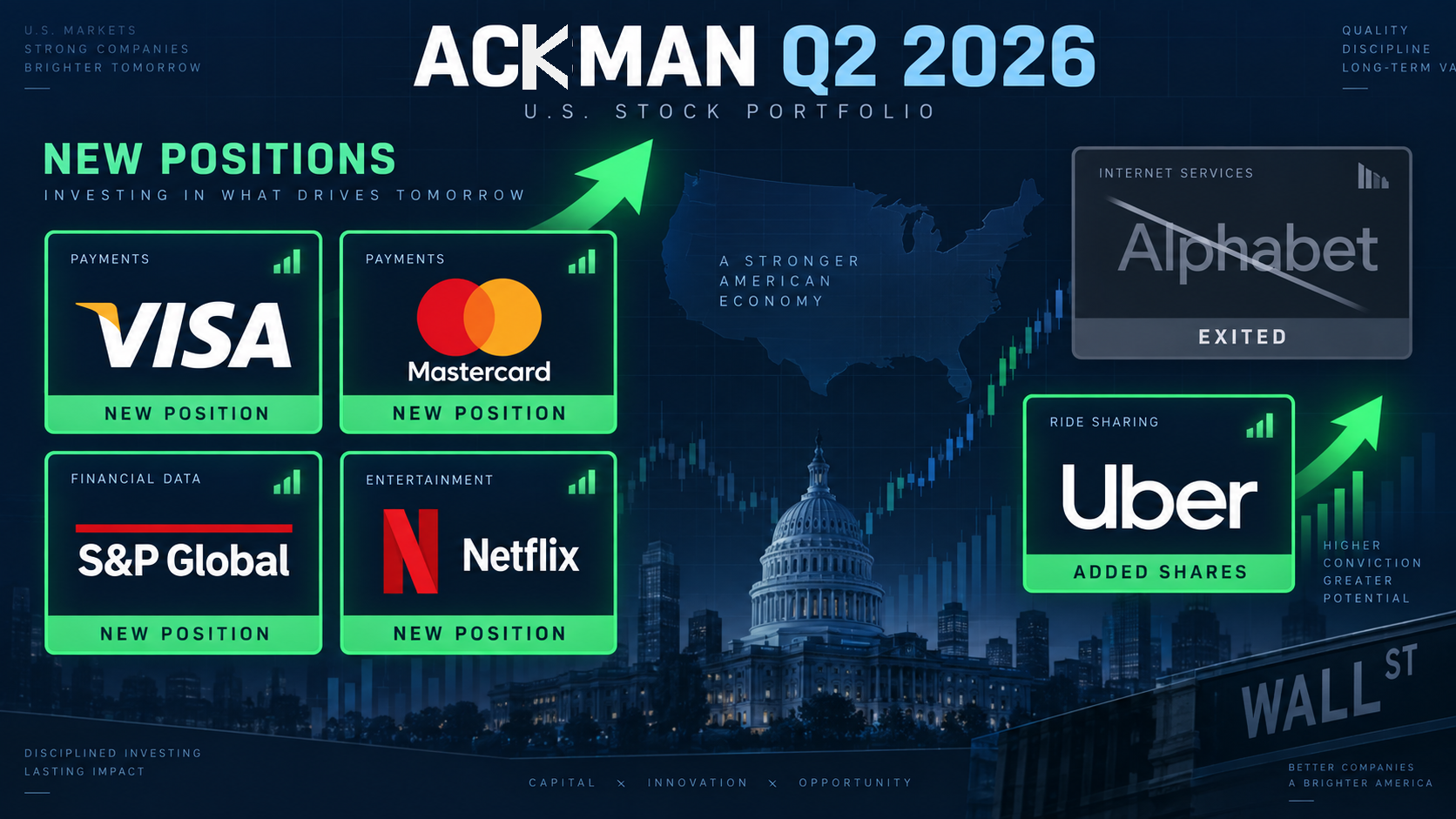
New positions from a manager famous for the conviction of "buying quality companies at a discount to intrinsic value" raise questions in themselves. Why payment networks and Netflix, and why now? And why unwind Alphabet entirely? This article lays out what was bought and sold based on the figures in the original 13F filing, and separates facts verifiable from the filing from interpretation.
A quick note on reporting format first. Starting this quarter, the Pershing Square Consolidated (PSCM) entity switched to a 13F-NT reporting no holdings, while U.S. equity holdings are reported aggregated on a single sheet via the PSUSA path. The figures below combine the reports from both filings and compare them with the prior quarter; names reported across both paths, such as HHH, are judged on an aggregated basis.
Four New Positions: Two Payment Networks, One Data Infrastructure Player, One Streaming Service
Four names appear newly in this quarter's 13F. All are complete new positions on paper, with no shareholding rows at all through last quarter.
Visa (V) and Mastercard (MA)
The 13F newly reports 3,270,470 shares of Visa and 2,124,646 shares of Mastercard. No separate public statement from Pershing Square on these new positions could be found. The only thing verifiable is the filing figures; note in advance that the discussion below includes interpretation.
Set against Ackman's existing logic, though, the direction is readable. The structure he has long favored is a business where a small number of brands control a global network and predictable fee cash flow builds as transactions grow. It is the same thread as the royalty model of Restaurant Brands International, the Burger King parent, and Uber's demand network — with two more tollbooths added, the ones the world's payments pass through. The fact that both are asset-light businesses earning high returns without heavy capital also fits his definition of "quality."
S&P Global (SPGI)
S&P Global was newly reported at 2,593,155 shares. The company runs an index business (S&P indices), credit ratings, and financial data under one roof, and here too, index licensing and data subscriptions generate recurring cash flow. Viewed alongside the two payment networks, it gives the impression of a quarter placing money into "the channels through which transactions and data flow." This too is an interpretation read from portfolio composition, not a statement.
Netflix (NFLX)
Netflix, at 13,081,465 shares, is by far the largest of the four new positions by share count. No public statement from Ackman on the Netflix initiation could be found. What can be said beyond the filing goes roughly this far: Netflix has been credited with more predictable subscription-based cash flow and a broader set of growth engines since introducing its ad tier. As a textbook case of a company with "assets competitors find hard to replicate," in Ackman's phrasing, it can be read as a fairly conventional conclusion for a quality-at-a-discount buy. But there is no way to confirm from the filing at what price or on what rationale he made the call.
Full Alphabet Liquidation: A Bet Reversed in One Quarter
Alphabet first entered the portfolio last quarter and disappeared entirely this quarter. All 344,102 shares — 311,726 GOOGL and 32,376 GOOG — were liquidated.
The 13F itself states no reason for the sale, but foreign media reports pointed to competitive concerns over the expansion of Google's robotaxi business (Waymo) as the background for the liquidation, which is consistent with this portfolio change. What is more interesting is the name sitting on the opposite side of the liquidation. In the same quarter, Ackman bought 14.6% more Uber. His statement at the time of the Uber initiation argued that "even in the robotaxi era, the side that aggregates passengers and demand — the demand layer — retains its value." He exited a company that directly owns autonomous-driving technology and bought more of a company that brokers demand even if that technology arrives. It reads as a wholesale shift in the direction of a bet on the same theme within a single quarter, but to be clear, this connection too is interpretation, not the filing.
How the Existing Core Moved
Uber (UBER) — 29,958,771 shares → 34,326,200 shares (+14.6%). The No. 1 holding on an aggregated basis, worth roughly $2.48 billion. On X (Twitter), Ackman called Uber "one of the best-run, highest-quality companies in the world" and assessed it as trading at a large discount to intrinsic value. Confidence in its trajectory under Dara Khosrowshahi — moving past a loss-making structure in 2017 to annual operating cash flow above $7 billion — was also cited as a reason.
Restaurant Brands International (QSR) — 22,645,483 shares → 25,821,284 shares (+14.0%). The franchise structure — collecting royalties and franchise fees rather than owning Burger King and Popeyes outright — is the prototype of the Ackman-style business model: predictable cash flow without much capital. He added roughly 3.17 million shares this quarter to a core he has held continuously since initiating the position in 2019.
Brookfield (BN) — 59,697,208 shares → 57,481,047 shares (-3.7%). Ackman has described the alternative-investment giant, which has compounded at around 19% annually for 30 years, as a roundabout way to invest in the AI infrastructure era at a discount to net asset value. He trimmed about 2.22 million shares this quarter, but it remains the largest holding by share count. Whether this is partial profit-taking or capital reallocation cannot be confirmed from the filing.
Howard Hughes (HHH) — Unchanged. Aggregating the reports from the PSCM and PSUSA paths, the position stands at 27,852,064 shares with no change. The original thesis — buying real estate development assets at a discount to net asset value — remains intact.
Hertz (HTZ) — 15,241,127 shares → 14,991,599 shares (-1.6%). A marginal trim. Citing Hertz's debt restructuring and improved vehicle procurement terms in April 2025, Ackman had previously grown the stake to around 20% and was involved in replacing management. It reads as a phase of gradual unwinding, but a large position is still being maintained.
Elsewhere, Amazon shrank 25.2%, from 11,451,981 to 8,563,857 shares, while Meta grew from 2,660,861 to 3,196,062 shares (+20.1%) and Microsoft from 5,654,078 to 6,206,730 shares (+9.8%). It is worth noting that even within Big Tech, the directions diverged.
Portfolio-Level Takeaway
This quarter's changes can be summarized in one line: a concentration into tollbooths. The four new positions share a common denominator — payment networks, index and data infrastructure, and subscription content. All are businesses that use little capital, sit on networks or rights that competitors find hard to replicate, and collect predictable cash flow. On top of that comes the settling of the robotaxi scenario via the Alphabet liquidation and additional Uber buying.
A few things deserve a cautious read, however. First, a 13F is a quarter-end snapshot, so the actual timing and prices of the liquidation and new purchases cannot be known. Second, no direct statement from Ackman on the new positions has been confirmed, so much of the "why he bought" is interpretation. Third, options positions and any trades after the 13F cutoff are not captured in this report. The filing figures show part of the outcome, not the whole of the judgment — and that is the last sentence this article wants to leave with you.
Disclaimer
This article summarizes 13F filings submitted to the U.S. Securities and Exchange Commission (SEC) along with public statements and press reports; it is not a recommendation to buy or sell any security, nor investment advice. 13Fs are filed up to 45 days after quarter-end, and there can be differences between the reporting date and actual positions. Investment decisions and responsibility rest with the investor.