On August 14, 2026, Berkshire Hathaway filed its Q2 13F with the SEC. It is the second quarterly report since Warren Buffett handed the CEO seat to Greg Abel, and this time it includes one number that is hard to pass over: Berkshire's hand, which had only been selling, tilted toward buying.
Subtracting the first quarter from the first-half cumulative cash flows in the 10-Q filed on August 10 shows the standalone Q2 flows: purchases of equity securities of about $23.47 billion and sales of about $3.69 billion. Net buying alone topped $19.7 billion. By the same method, Q1 worked out to roughly $15.94 billion in purchases and $24.09 billion in sales—a net sale of about $8.15 billion. That flow flipped in a single quarter. By foreign press tallies, this was the quarter that ended a net-selling streak stretching back 14 consecutive quarters, and the largest net buying in roughly three years. That said, the range I cross-checked directly against the original documents covers only this year's Q1 and Q2 flows; the 14-quarter part is quoted from press calculations. Share repurchases also totaled about $4.44 billion in the first half per the 10-Q, and with Q1 purchases reported by the press at a mere $235 million, virtually all of it was concentrated in Q2.
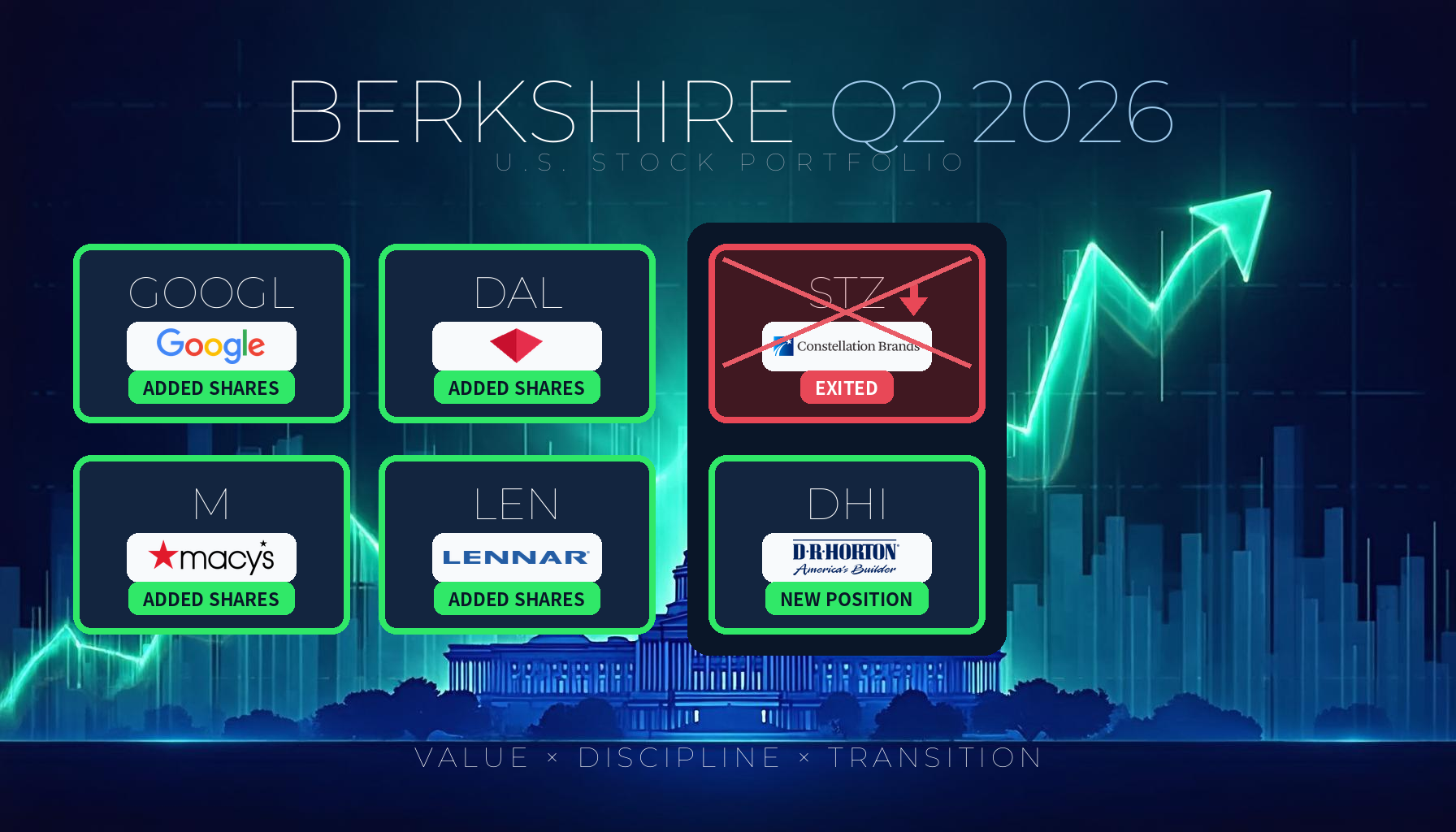
Here is a table of the quarter's major moves.
| Category | Holding | Shares, end of Q1 → end of Q2 | Change |
|---|---|---|---|
| Added | Alphabet (A + C combined) | 57,835,013 → 105,979,600 | +83.2% |
| Added | Delta Air Lines | 39,809,456 → 57,320,000 | +44.0% |
| Added | Macy's | 3,038,355 → 7,347,426 | +141.8% |
| Added | Lennar (A + B combined) | 10,337,345 → 13,409,858 | +29.7% |
| Reduced | Bank of America | 513,624,165 → 483,394,015 | -5.9% |
| Reduced | Kroger | 50,000,000 → 39,000,000 | -22.0% |
| Reduced | Nucor | 3,907,075 → 1,857,752 | -52.5% |
| Reduced | Capital One | 7,150,000 → 3,000,000 | -58.0% |
| Liquidated | Constellation Brands | 632,890 → 0 | Full exit |
| New | D.R. Horton | — → 3,564 | New |
The change this quarter is not a mere resumption of buying but a swing to net buying, with purchases far outpacing sales.
Alphabet: Share Count Up 83%
The star of this quarter is unmistakably Alphabet. Berkshire's Alphabet position, valued at $16.63 billion at the end of Q1 (6.3% of 13F holdings), grew to $37.76 billion by the end of Q2 (12.6%). In share count, that is 57,835,013 shares to 105,979,600, up 83.2%. After Class A shares rose 45.2%, the small remaining Class C stake ballooned from 3,585,215 shares to 27,188,433. By market value aggregated by company across the 13F-reported holdings, it now sits third behind Apple (22.0%) and American Express (17.1%).
On this position, Buffett confirmed in a July 15, 2026 CNBC interview that he was the one who started it: "I initiated it." He added that there is nothing Abel does that he does not approve of, and nothing he does that Abel does not approve of. He even cited not buying Alphabet sooner as a mistake. What is interesting is the timeline. The accumulation shown in the 13F was already complete by the end of June, before the interview, so the remarks amount to a belated public confirmation. Reading it as far as Buffett personally directing this round of buying, however, is another story. (I covered the background behind Buffett's interest in Alphabet separately in an earlier post, Why Did Warren Buffett Buy Google?.)
Banks Shrank, Airlines Grew
The standout on the selling side is Bank of America. Berkshire cut 30.23 million shares, bringing the position to 483,394,015 shares—a reduction worth roughly $1.7 billion. Compared with mid-2024, when the stake exceeded 1 billion shares, it is now less than half, and the trimming continued into this quarter.
In the same quarter, Delta Air Lines shares grew from 39,809,456 to 57,320,000, up 44.0%. By value that is about $5.4 billion, or 1.8% of the 13F-reported holdings. It is a famous story that when Berkshire sold its entire airline stake at the outset of the pandemic in 2020, Buffett described it as an 'understandable mistake'—and he now holds 44% more of that airline stock than at the end of Q1. Banks shrank and airlines grew in the same quarter, but nowhere in the filings is there evidence of a direct movement of funds between the two trades. Still, the direction in which weight shifted within the portfolio reads clearly.
A Position That Appeared in One Quarter and Vanished the Next
The most attention-grabbing record in this 13F is Constellation Brands. Berkshire added 632,890 shares (about $94.9 million) in Q1, and in Q2 they disappeared entirely. On the 13F it is a one-quarter position, but there is no way to know from quarter-end snapshots alone how many weeks it was actually held. As for the thinking behind it, the 13F does not say.
The cleanup continued elsewhere as well: Kroger -22.0%, Capital One -58.0%, Nucor -52.5%. Foreign media have suggested this is the unwinding of the book managed by Todd Combs, the former portfolio manager who left Berkshire at the end of 2025. Of course, the 13F does not tell us who did the buying, so this remains squarely in the realm of interpretation. But the numbers do tell us that the positions trimmed and the positions filled diverged sharply this quarter.
Just One New Line—3,564 Shares at That
The only new row in the entire 13F is D.R. Horton: 3,564 shares, worth about $580,000. Against roughly $300 billion in 13F-reported holdings, its weight is essentially meaningless. Rather than forcing significance onto it, it seems appropriate to leave it as a matter of record.
That said, the tilt toward housing and domestic demand reads more broadly than this single new line. Homebuilder Lennar grew +29.8% in Class A and +25.4% in Class B, and department store Macy's saw an additional 141.8% of accumulation. Money flowed not only into big tech but also into U.S. domestic consumption and housing this quarter. Whether that flow is a one-off or an expansion, the next quarter's 13F may tell us.
Conclusion
In my view, the essence of this 13F is not any particular stock but the shift itself. The net selling of Q1 turned into large-scale net buying in Q2, and Buffett himself stated that he was the one who initiated the Alphabet position. Since this is not yet confirmation that Buffett directed a reversal of Berkshire's overall trading direction, it seems more reasonable to read the filing around the actual change in capital allocation rather than the attribution of individual trades. It is still too early to draw the line between the successor's independent bets and inherited ones, and the standard for reading Berkshire's numbers may well move from 'who decided' to 'what was approved.' Perhaps that is also a sign that the boundaries of value investing are shifting right now.
Of course, as always, the 13F is only a snapshot as of June 30, 2026, and it may differ from the positions held at this very moment.
References
- Disclaimer: This post is informational content summarizing regulatory filings, analysis, and the author's views; it is not a recommendation to buy or sell any particular stock.