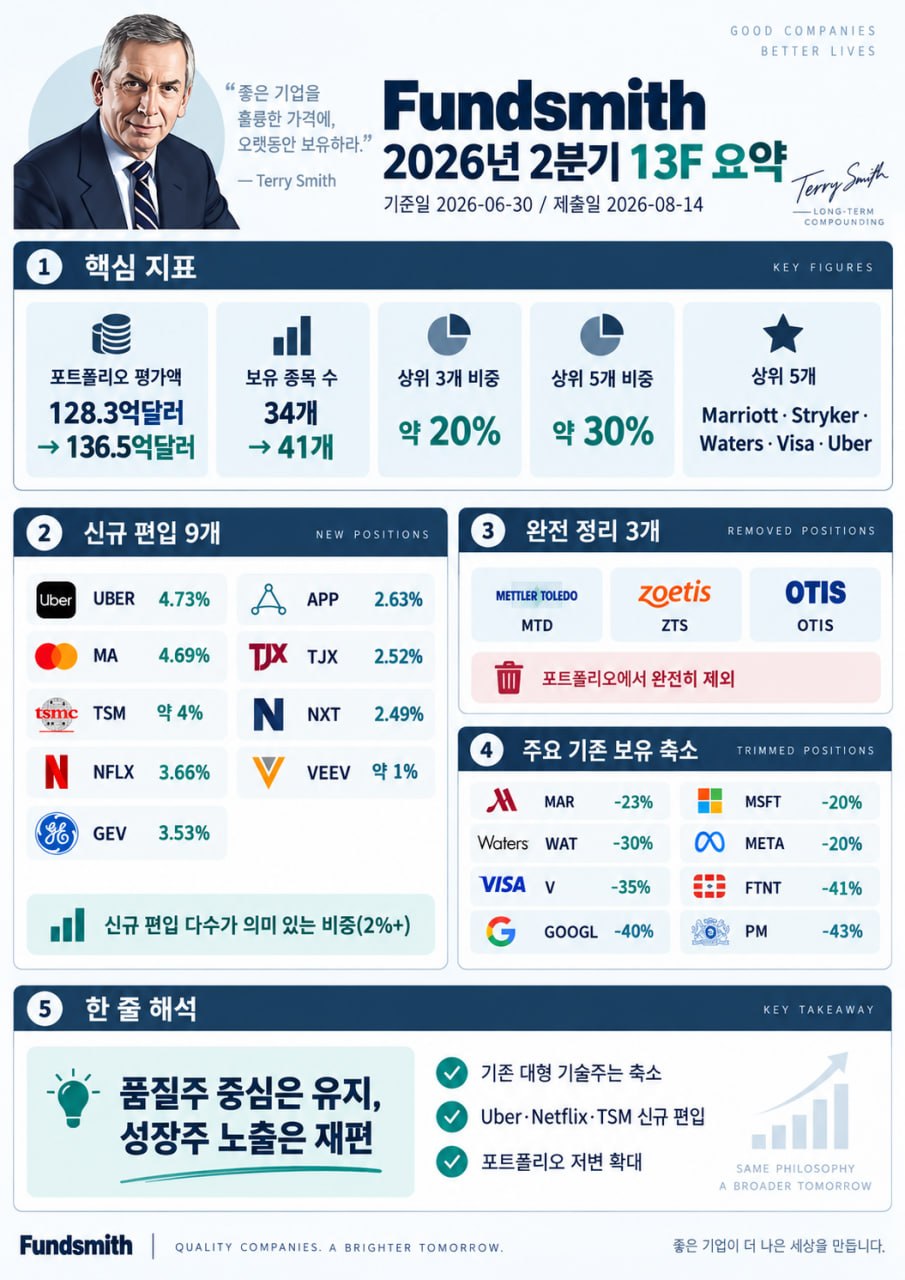
Fundsmith's Q2 2026 13F, filed on August 14, 2026, lays out the changes in Terry Smith's portfolio. The reporting date is June 30, 2026. This quarter, the fund's 13F value grew from $12.83 billion to roughly $13.65 billion, while the number of holdings expanded from 34 to 41. Of those, 23 stocks each account for more than roughly 1% of the portfolio — the group where Terry Smith's hand is most clearly visible.
Terry Smith is the UK's best-known quality investor, often dubbed the "British Warren Buffett" by international media. A former analyst, he made his name in finance with his 1992 book Accounting for Growth, which exposed the accounting illusions of UK companies at the time. After serving as CEO of broker Collins Stewart and interdealer broker Tullett Prebon, he founded Fundsmith in London in 2010. His investment approach boils down to the fund's one-line slogan: Buy good companies. Don't overpay. Do nothing. To him, a "good company" is one with high returns on capital, a durable competitive advantage, low debt, and a business model that isn't shaken by rapid technological change — which is why he has traditionally kept his distance from the fast-changing technology sector and financial stocks. He is also well known for using his annual shareholder letters to criticize the fund industry's frequent trading and high-fee structures.
For a manager like that to add 9 brand-new positions and fully exit 3 stocks in a single quarter is a major move in itself. Drawing on Seeking Alpha's analysis and the filed figures, this article examines what was bought, what was sold, and what that direction signals.
Fundsmith 13F Summary: Q2 2026
| Category | Details |
|---|---|
| Filing entity | Fundsmith (Terry Smith) |
| Report | Q2 2026 13F (as of 2026-06-30, filed 2026-08-14) |
| Portfolio value | $12.83B → ~$13.65B |
| Number of holdings | 34 → 41 |
| Top 3 holdings weight | ~20% |
| Top 5 holdings weight | ~30% (Marriott, Stryker, Waters, Visa, Uber) |
A reminder worth repeating: a 13F is a snapshot of holdings at quarter-end. Exact buy and sell dates and prices are not disclosed, and the "buy price ranges" in this article are estimates that outside analysis has derived from the quarter's trading range.
For reference, Fundsmith's flagship Fundsmith Equity Fund (launched in 2010) has returned an average of 13.1% per year since inception, versus 12.3% for the MSCI World Index over the same period. 2022 was also the fund's first negative year since launch, at -13.8%.
New Positions: 9 Stocks, Many Now Trading Above the Buy-In Range
Nine stocks entered the portfolio this quarter. Ranked by weight:
| Stock (Ticker) | Weight | Estimated Buy Price Range | Current Price |
|---|---|---|---|
| Uber Technologies (UBER) | 4.73% | $61–94 | $78.82 |
| Mastercard (MA) | 4.69% | $465–534 | ~$595 |
| Taiwan Semi (TSM) | ~4% | $327–479 | ~$418 |
| Netflix (NFLX) | 3.66% | $71–109 | $81.72 |
| GE Vernova (GEV) | 3.53% | $856–1,182 | ~$912 |
| AppLovin (APP) | 2.63% | $379–614 | ~$318 |
| TJX Companies (TJX) | 2.52% | $146–170 | ~$135 |
| Nextpower (NXT) | 2.49% | $104–163 | $82.03 |
| Veeva Systems (VEEV) | ~1% | $148–192 | ~$277 |
What stands out is that the heart of the new additions consists of stocks long classified as "growth" names, such as Uber and Netflix. Uber in particular is a large new position that lands inside the portfolio's top five. Terry Smith has historically weighted consumer staples, healthcare, and financial infrastructure over tech, and these purchases suggest the boundaries of that taste are shifting.
Of the 9 new positions, MA, TSM, GEV, VEEV, and UBER currently trade above their estimated buy price ranges, while APP, TJX, NXT, and NFLX trade below. The scoreboard versus the quarter's average cost is mixed, but judged by the sheer size of the additions, Fundsmith aggressively repositioned itself this quarter.
Full Exits: Mettler-Toledo, Zoetis, and Otis
On the other side, three stocks disappeared from the portfolio entirely.
- Mettler-Toledo (MTD): A 5.59% position built in the first half of 2022 at $1,098–1,675. The fund added to it again in Q1 2024 but sold the entire stake this quarter at $1,023–1,366. The stock now trades around $1,399, well above the exit range.
- Zoetis (ZTS): A 3.57% position initiated mainly around $154 in 2025 and built up over nearly three years. It was closed out this quarter at $72–123. The stock now trades at $77.34.
- Otis Worldwide (OTIS): A 1.64% position initiated in Q3 2022 at $64–82. After a roughly 47% trim in last year's fourth quarter, the remaining shares were fully sold this quarter at $69–83. The stock now trades around $72.
With all three exited names, the share price has in many cases climbed above the range at which the fund sold — so while these were hardly exits timed with pinpoint precision, it is a stretch in which the fund's decisions to sell have held up reasonably well. That said, by the nature of 13F filings, the reasons for the sales are not disclosed.
Existing Holdings: A Marathon of Continued Trims
Reductions in existing holdings stand out this quarter. Changes among the top holdings by weight:
| Stock (Ticker) | Latest Weight | Change This Quarter |
|---|---|---|
| Marriott (MAR) | ~7% | trimmed ~23% |
| Stryker (SYK) | 6.72% | small ~5% trim |
| Waters (WAT) | 6.25% | trimmed ~30% |
| Visa (V) | ~5% | sold ~35% |
| Alphabet (GOOGL) | 4.64% | trimmed ~40% |
| Church & Dwight (CHD) | 4.58% | continued minor adjustments |
| P&G (PG) | 4.38% | continued minor adjustments |
| Microsoft (MSFT) | 4.36% | trimmed ~20% |
| Meta (META) | 4.34% | trimmed ~20% |
| ADP | 4.27% | trimmed by about a third |
| Fortinet (FTNT) | ~4% | sold ~41% |
| IDEXX (IDXX) | 3.93% | sold ~30% |
| Texas Instruments (TXN) | 3.93% | trimmed ~30% |
| Philip Morris (PM) | 3.86% | trimmed ~43% |
Look at the structure and an interesting contrast emerges. The trimmed list contains many tech names — MSFT, META, GOOGL — that have been cut for several consecutive quarters, and the same downward direction extended to names like FTNT, IDXX, and TXN. The new arrivals, meanwhile, are growth stocks on a different axis: UBER, NFLX, and TSM. It reads as a "sold tech, bought other growth stocks" pattern.
This dovetails with the message Terry Smith has repeated in his recent shareholder letters. In his 2024 letter, he pointed to the concentration of market returns generated by the Magnificent Seven, warning that just as the great companies of the past were not great forever, today's leaders will be no different.
The Takeaway: Quality Intact, Growth Exposure Widened
Taken as a whole, Fundsmith's 13F this quarter can be summarized as maintaining its quality-stock-centered stance while broadening the portfolio's base and reshaping its exposure to growth stocks.
- Portfolio value and the number of holdings both grew, and most of the 9 new positions carry meaningful weights of 2% or more.
- The top holdings (Marriott, Stryker, Waters, Visa) remain centered on consumer, healthcare, and payments infrastructure.
- The trimming of existing tech names (MSFT, META, GOOGL) continued this quarter, extending a run of three or more consecutive quarters of reductions.
- New growth stocks such as Uber, Netflix, and TSM have filled that space, changing the "quality" of the portfolio's growth exposure.
Conclusion
Terry Smith is a manager who has built his long-term track record on a principle that looks simple: "buy good companies and hold them for a long time." For new additions and full exits to happen this heavily and simultaneously in his portfolio can be read as a signal that, by his own standards, a reassessment of what defines a "good company" is underway. Of course, a 13F is a snapshot of a single point at quarter-end, and neither the timing nor the reasons for the trades are disclosed.
Whether this quarter's changes turn out to be a one-off rebalancing or a shift in the fund's character, next quarter's 13F will supply the answer.
---
Disclaimer: This article is informational content summarizing filings, outside analysis, and the author's views; it is not a recommendation to buy or sell any particular stock.