When You Want to Ride the Semiconductor Bull Market But Fear Buying at a Peak
The strongest leaders in the domestic stock market are Samsung Electronics and SK Hynix. With AI semiconductors, HBM, the recovery of the memory sector, and foreign capital inflows converging at once, these two stocks are effectively directing the direction of the Korean stock market.
The problem is the burden investors feel after prices have already risen significantly. While there is still a possibility that Samsung and SK Hynix will rise further, investing now simultaneously raises the worry of getting caught at a short-term peak. Conversely, if they don't join now, there is a sense of anxiety that they will feel even more left out.
For a situation like this, a product worth looking at is the TIME Korea Plus Dividend Active ETF (441800). This is an active domestic stock ETF that holds market leaders like Samsung and SK Hynix while simultaneously including financials, holding companies, and dividend-focused stocks. Unlike heavily betting on a single stock, the structure aims to participate in the domestic stock rally while simultaneously chasing monthly dividend cash flow.
What exactly is this ETF?
The TIME Korea Plus Dividend Active ETF is an active domestic stock ETF managed by TIMEFOLIO Asset Management. While the benchmark is the KOSPI 200, it is not a passive ETF that simply follows the index. The asset manager uses an active strategy that adjusts holdings and weights according to market conditions.
The core phrase for the product is summarized as an "active ETF seeking both monthly dividends and capital gains." Unlike conservative high-dividend ETFs that hold only dividend stocks, this product is closer to one seeking performance by mixing in growth leaders and large caps with dividend appeal.
As of official data, the listing date of this ETF is September 27, 2022, and the total expense ratio is a significant 0.80% per year.
The reason to propose this ETF to those hesitant to invest in Samsung or SK Hynix lies in the weighting. As of June 26, 2026, SK Hynix and Samsung Electronics are listed together in the top ranks of constituents. SK Hynix accounts for 19.72%, and Samsung Electronics for 14.98%. The sum of these two alone is around 34.70%.
Furthermore, it includes Samsung Electro-Mechanics, SK Square, Samsung C&T, SK, Samsung Life, and other large-cap affiliates or highly related stocks. In this structure, it is difficult for the ETF to be completely left out if Samsung or SK Hynix rises further. If the semiconductor-centered rally in the Korean stock market continues, the effects are reflected to some extent within the ETF.
Conversely, by also bringing in non-semiconductor sectors like Palbix (Palyong Food), securities stocks, Hyundai Department Store, and holding companies—sectors with growth expectations while also paying dividends—it is lowering the burden of semiconductor overheating.
What are the specific constituent holdings of TIME Korea Plus Dividend Active?
As of June 26, 2026, the top constituent holdings are as follows, and real-time holdings can be checked through the TIMEFOLIO product page.
| Rank | Ticker | Weight |
|---|---|---|
| 1 | SK Hynix | 19.72% |
| 2 | Samsung Electronics | 14.98% |
| 3 | Samsung Electro-Mechanics | 6.34% |
| 4 | SK Square | 6.22% |
| 5 | Samsung C&T | 3.93% |
| 6 | Palbix (Palyong Food) | 3.86% |
| 7 | SK | 3.54% |
| 8 | Samsung Life | 3.07% |
| 9 | NH Investment & Securities | 2.80% |
| 10 | Hyundai Department Store | 2.76% |
As introduced earlier, the top holdings include large-cap tech stocks that can expect benefits from semiconductors and AI infrastructure. Behind them are mixed holding companies, insurers, securities, consumer goods, and distribution stocks. It is not simply a collection of high-dividend stocks with no growth expectations. One can view it as holding both semiconductor cycle leaders, which can be considered the two pillars of the current KOSPI market, and shareholder return expected stocks simultaneously.
How much monthly dividend can be expected?
The reason this ETF is attractive is that it aims for a monthly dividend. The official product page indicates payment dates as the last business day of the month and the end of the fiscal period. The payment timing is within 7 business days starting from the day after the record date.
Looking at recent distribution records, the monthly amount is not fixed. From January 2026 to June 2026, the dividend per share was 117 won, 148 won, 267 won, 154 won, 181 won, and 368 won respectively, while the stock price rose by about 75%. In other words, assuming an investment of 100 million won at the beginning of the year (stock price approx. 20,000 won, 5,000 shares), the value as of the end of June would be approximately 1.87 billion won, and the dividend amount could be expected to reach as high as 1.84 million won, including special dividends.
Monthly distribution amounts are around 0.3 to 0.5%, and distribution rates appeared higher than this in March and June when special dividends were included. Dividing the total distribution of 2,045 won in the last 12 months by the same base price results in an annual distribution yield of approximately 5.92%.
One should not overly rely on this product for fixed income or planning retirement, as expecting fixed dividends is risky. However, the advantage of a cash flow on a monthly basis is certainly a benefit for investors. Monthly dividends received can stabilize investment psychology and help long-term investing. Sometimes, they can also be used as reinvestment or a supplement for living expenses.
What is a Special Dividend?
While the word "special dividend" was mentioned earlier, looking up information on this ETF, one easily encounters the keyword "special dividend."
It may seem like a special privilege, but in reality, a special dividend is not a bonus the asset manager gives to investors as separate money. It is a method of distributing a portion of distributable funds generated inside the ETF, such as dividends, trading profits, and performance fees, in addition to regular dividends.
In a stock market rising sharply like these days, the valuation gains or trading profits of holdings within the ETF can increase. The asset manager can realize part of this and return it as dividends, allowing investors to receive cash flow. In other words, special dividends are closer to "distributing a portion of internal performance as cash" rather than "the manager giving an additional bonus."
However, the benefit is not non-existent. The taxation method for dividends and trading profits of domestic stock ETFs can vary depending on the product structure and tax base. If domestic stock trading profits are included in the distribution fund during a bull market, the tax base decreases, and investors can expect cash flow and tax advantages.
Therefore, it is accurate to view special dividends not as unconditional additional income, but as a distribution method that converts internal ETF performance into cash flow during a bull market. When a special dividend is paid, the dividend lock effect may be reflected in the ETF's base price, and there is no guarantee that this will be repeated at the same level.
How reliable is TIMEFOLIO's track record?
If you think, "It's good, but isn't it a product relying too much on the asset manager's skill?" then you are thinking exactly right. If you want to buy an active ETF, the part you must check is the asset manager's skill. The way to check skill is simpler than you might think. Just look at how much they beat the index or how stable they have operated.
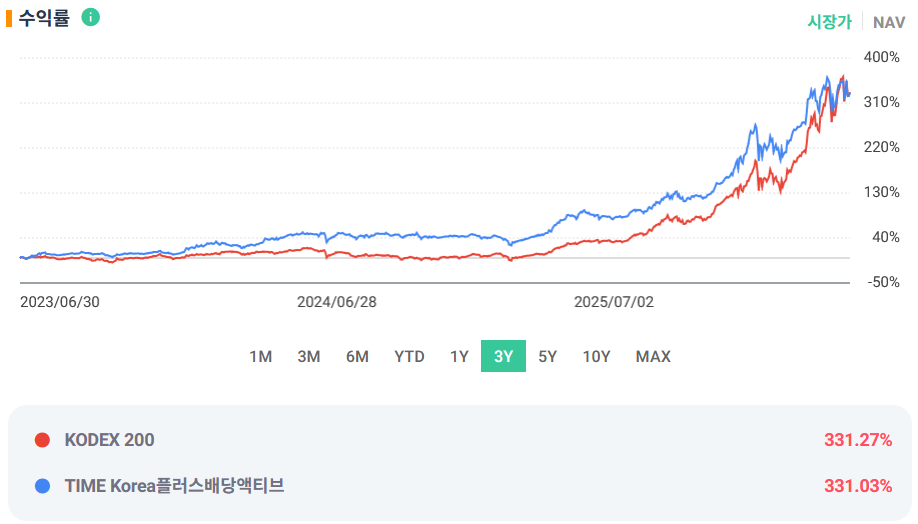
Recent 3 years, TIME Korea Plus Dividend Active vs KODEX 200 Comparison (ETF Check)
The graph above shows the performance of the KOSPI 200 and TIME Korea Plus Dividend Active over the last 3 years. While one might say "they lost," it isn't that simple. There are some limitations with active ETFs, one of which is that they are not allowed to invest more than 30% in a single stock. Since the majority of ETF investors aim for diversification, this is usually not a major weakness.
However, in South Korea, where the semiconductor rally has continued for over a year, it has not been easy for an active ETF with more than 50% semiconductor exposure to beat a passive ETF. Despite the heavy penalty of being an active ETF (limited to domestic markets this year), the fact that the 3-year performance is similar to a passive ETF means the selection of non-semiconductor stocks was quite excellent.
Even so, if TIMEFOLIO's track record doesn't seem trustworthy with just this evidence, the following example might help.
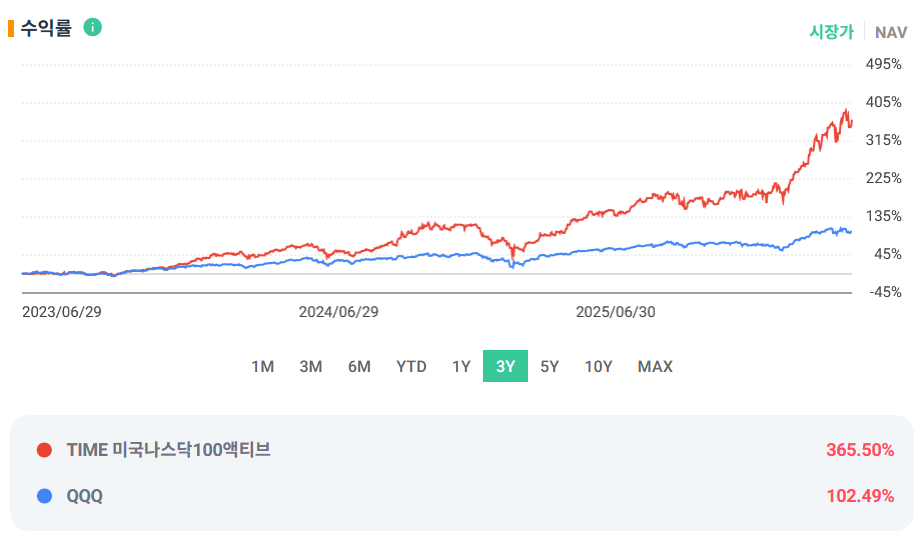
Recent 3 years, TIME US Nasdaq 100 Active vs QQQ (Leading US Listed NASDAQ Tracking ETF) Comparison (ETF Check)
In the past 3 years, it beat QQQ, a representative ETF tracking the NASDAQ index, by over 3 times. Anyone familiar with what the NASDAQ index looks like and how it performed can realize how incredible that number is.
Must-Check Points Before Investing
Before looking at this ETF, it is good to check three things.
First, the holdings weights change continuously. Currently, semiconductor leaders are included with high weight, but as it is an active ETF, we cannot know when or how much they will change. Just comparing last week alone, the weights of the two stocks were adjusted by about 3%. If you want a fixed weight + diversification strategy for Samsung and SK Hynix, it is correct to buy a semiconductor ETF or a KOSPI 200 tracking ETF.
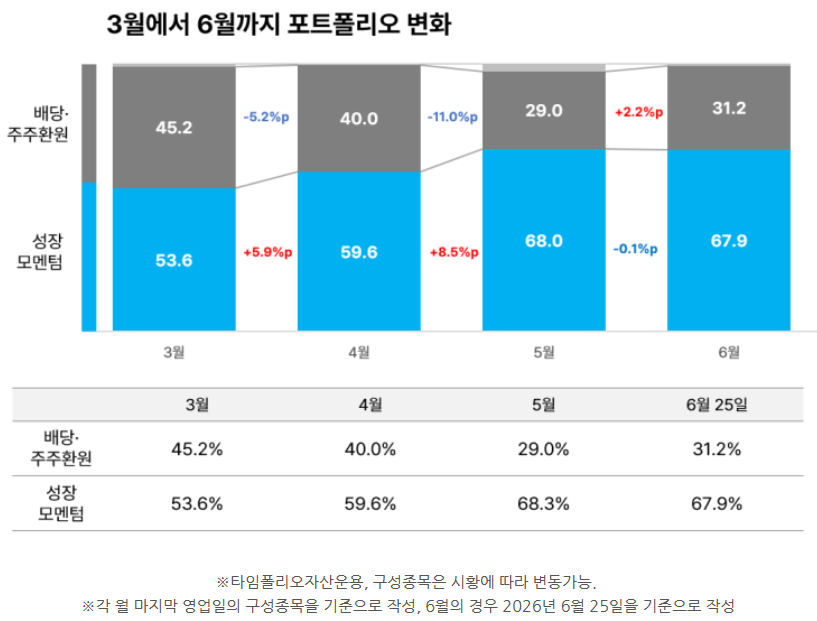
Recent 3-month constituent weight changes of TIME Korea Plus Dividend Active (TIME ETF Blog)
Second, the sustainability of dividends. Regardless of stock price fluctuations, this stock has a very different nature from traditional dividend stocks. In the case of traditional dividend investments like SCHD, SPHD, or Realty Income, which were once popular, investment focuses on stocks that have continuously maintained and grown dividends, so the likelihood of the dividend amount itself decreasing is small. However, this stock is not like that. Because it holds growth stocks at a significant weight, the dividend yield itself is also influenced by capital gains, i.e., special dividends.
Third, total expense ratio and actual costs. The official total expense ratio is 0.80% per year. As it is an active ETF, the cost is so high that it cannot be compared with a general KOSPI 200 passive ETF. Therefore, as mentioned above, the key decision criterion is whether you can trust the asset manager's stock selection and dividend strategy enough to bear that cost.
Can I do this myself?
You might think about trying to follow it by looking at the list of stocks exposed on the TIMEFOLIO homepage. It's a good idea. You could even try using trendy things like Vibe coding. However, actually doing it means you have to hold a large number of stocks, making account management difficult, and responding late to portfolio changes or executing rough trades can result in annual trading costs exceeding 0.8%. If you actually do it yourself, you will probably think quite high probability that various costs are not that expensive compared to 0.8%.
Conclusion
The TIME Korea Plus Dividend Active ETF is an interesting option for investors who feel Samsung Electronics and SK Hynix are too expensive to buy but do not want to be completely left out of the Korean stock market rally. With a high weighting of semiconductor leaders, it offers participation in the rally, and by including financial stocks and dividend-oriented stocks, it softens the portfolio structure slightly.
In one sentence, to summarize:
It is a domestic stock active ETF that follows the rise of Samsung Electronics and SK Hynix while lowering psychological burden with monthly dividends and diversification.
This product is not a stable substitute for a deposit, nor is it merely a high-dividend defensive ETF. It is a hybrid product of offense and defense combining semiconductors and dividends. Therefore, the investment point is clear. It should be added to a list of interests for investors who want to participate in the domestic stock market rally, want monthly dividend cash flow, and want to avoid putting all eggs in one basket.
Before investing, you must check the latest constituent stocks, dividends, total expense ratio, base price volatility, and tax structure. Especially for this ETF, since it is an active ETF, you should not assume that today's portfolio will remain the same several months later.
References
- TIMEFOLIO TIME ETF Official Product Page: https://timeetf.co.kr/m11_view.php?idx=12
- TIMEFOLIO Asset Management News, TIME Korea Plus Dividend Active ETF 3rd Consecutive Special Dividend Implementation, 2026-03-26: https://timefolio.co.kr/en/board/board.php?bbsid=news&idx=199
- Daum News, TIME Korea Plus Dividend Active ETF, Second Special Dividend This Year, 2026-06-25: https://v.daum.net/v/20260625174210839
- Moleg (Ministry of Legislation), 16 Legislation Announcement Bills Including Bill to Expand "Fiduciary Duty" Subject to Shareholders passed by National Assembly, 2025-07-15: https://www.moleg.go.kr/board.es?act=view&bid=0048&cgcode=&keyField=&keyWord=&listno=136361&mid=a10501000000&nPage=10&pageCntBySelf=10&tag=
- Ministry of Justice, Justice Bill to Mandate Share Repurchase passed at the National Assembly Plenary Session, 2026-02-25: https://www.moj.go.kr/bbs/moj/182/603762/artclView.do
- Financial Services Commission, Announcement on Disclosure of Target Companies for Dividend Income Taxation Special Treatment: https://www.fsc.go.kr/no010101/86322