As AI grows, does Google stand to gain or to lose? Picturing people asking questions of conversational AI instead of typing into a search box raises worries about the advertising business. Yet watching companies rent Google's computing resources to run AI, you might also wonder whether there's a better growth opportunity than this.
The two scenes aren't contradictory. The same technology can change how an existing business makes money while bringing new customers to a different one. Viewed from the standpoint of a shareholder in Alphabet, Google's parent company, today's question goes beyond surviving the AI race. It's closer to whether the company can defend the revenue base of core search while turning new AI demand into cash left over after investment.
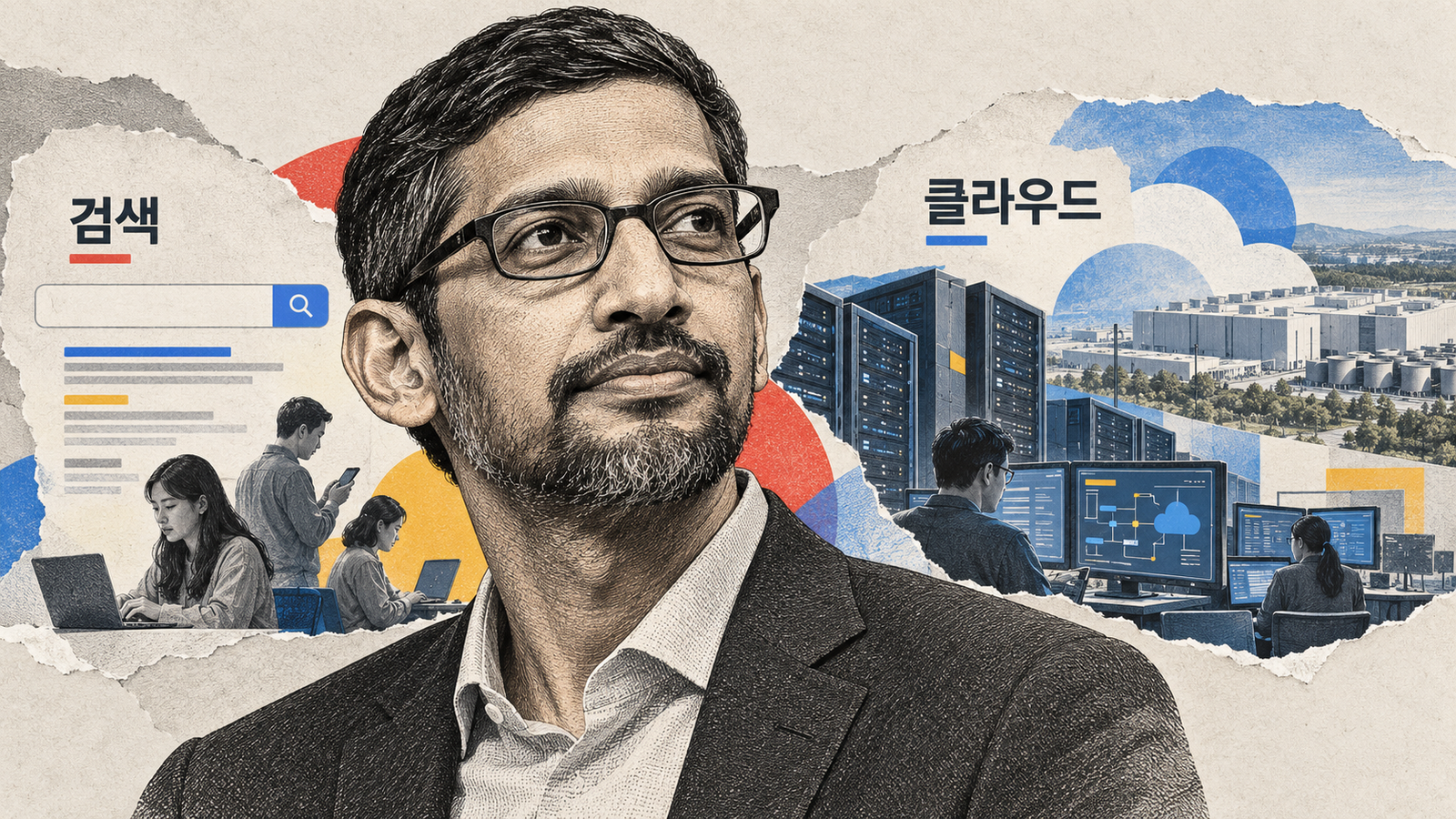
First, Untangle the Claim That Search Revenue Is Falling
In the Q3 2026 results Alphabet announced on October 28, Search and other advertising revenue was $63.35 billion, up 12% from the same quarter a year earlier. Based on this number alone, you can't say search revenue declined.
That doesn't mean there's nothing to worry about, either. The fact that revenue grew and a verdict that the pace of growth or future profitability is satisfactory are different matters. The tension surrounding Google begins with this distinction.
On the earnings call, Philipp Schindler pointed to foreign exchange as the biggest cause of the slowdown in search growth versus the prior quarter, while also explaining that AI Mode's lower level of monetization had an effect. That's different from the claim that AI has already broken search, but it is transitional friction that Google itself acknowledges.
Under the old model, users hunted for information, ads were placed along that journey, and value was delivered to advertisers. In AI search, questions run longer, conversations continue, and the way users get answers changes. Even if people search more, naturally attaching ads to that experience and getting paid for them is a problem that has to be solved separately.
Sundar Pichai laid out the approach of building a good user experience first in search's AI transition, then following with monetization. For users, that may be a sensible order. Shareholders, though, also see the costs incurred along the way and the gap in timing before revenue arrives, because the pace at which questions multiply and the pace at which each question converts into money won't necessarily match.
The company said year-over-year growth in search queries this quarter was the highest in the past five years. That makes it hard to explain search's problem as simple user attrition. Cyn Research on Seeking Alpha also noted in its public summary that query growth and AI Mode's low monetization are appearing at the same time. What matters now is not just whether people are searching less, but how much revenue Google earns from the growing volume of questions. It's also worth keeping in mind that query counts and revenue growth rates alone can't precisely reverse-engineer revenue or cost per query.
Cloud Isn't a Hope — It's a Business That's Already Big
If search is the problem of defending an existing revenue base, cloud is the side absorbing new demand. It's the business of providing enterprise customers with compute and storage capacity, AI models, data-processing tools, and the like, and being paid for it.
In Q3, Google Cloud revenue was roughly $30.7 billion, up 103% year over year, and segment operating income was roughly $11.1 billion. That's a different picture from growth in which revenue rises while losses deepen. Operating margin reached 36.2% as well.
The scale has changed too. Cloud now accounts for about 24% of Alphabet's consolidated revenue. It has grown too large to be viewed only as "a business that might someday complement search." That share is the same-quarter cloud revenue in the company's disclosures divided by consolidated revenue.
Still, that 103% growth rate shouldn't be read as a single story. The company said that alongside AI infrastructure, AI solutions, and existing cloud services, sales of systems based on its own AI compute chip, the TPU, also contributed meaningfully to growth. A business that delivers services continuously based on usage and a business that manufactures and supplies hardware can differ in how they generate revenue and collect cash.
Nor should this quarter's margin be extrapolated straight into the future. Management explained that it plans to increase the use of third-party compute capacity to meet demand, which could weigh on cloud margins in the near term. Strong demand and the ability to serve that demand at the best cost are separate challenges.
Backlog also helps when sizing up future demand. Management said the cloud backlog stands at $561 billion, with slightly more than 55% of it expected to be recognized as revenue over the next 24 months. But backlog is neither cash received today nor profit left tomorrow. If compute capacity and equipment must be secured first to fulfill contracts, a large backlog and immediate cash strain can grow together. That's why evidence that demand exists and evidence that the demand is being served at good margins should be examined separately.
The Cash Decline Can't Be Pinned on Search Alone
In Q3, Alphabet's operating cash flow was about $42.3 billion while capital expenditure was about $51.4 billion. Free cash flow — the difference between the two — was a deficit of about $9.1 billion. It isn't that the business stopped bringing in cash; more money was poured into equipment than came in the door.
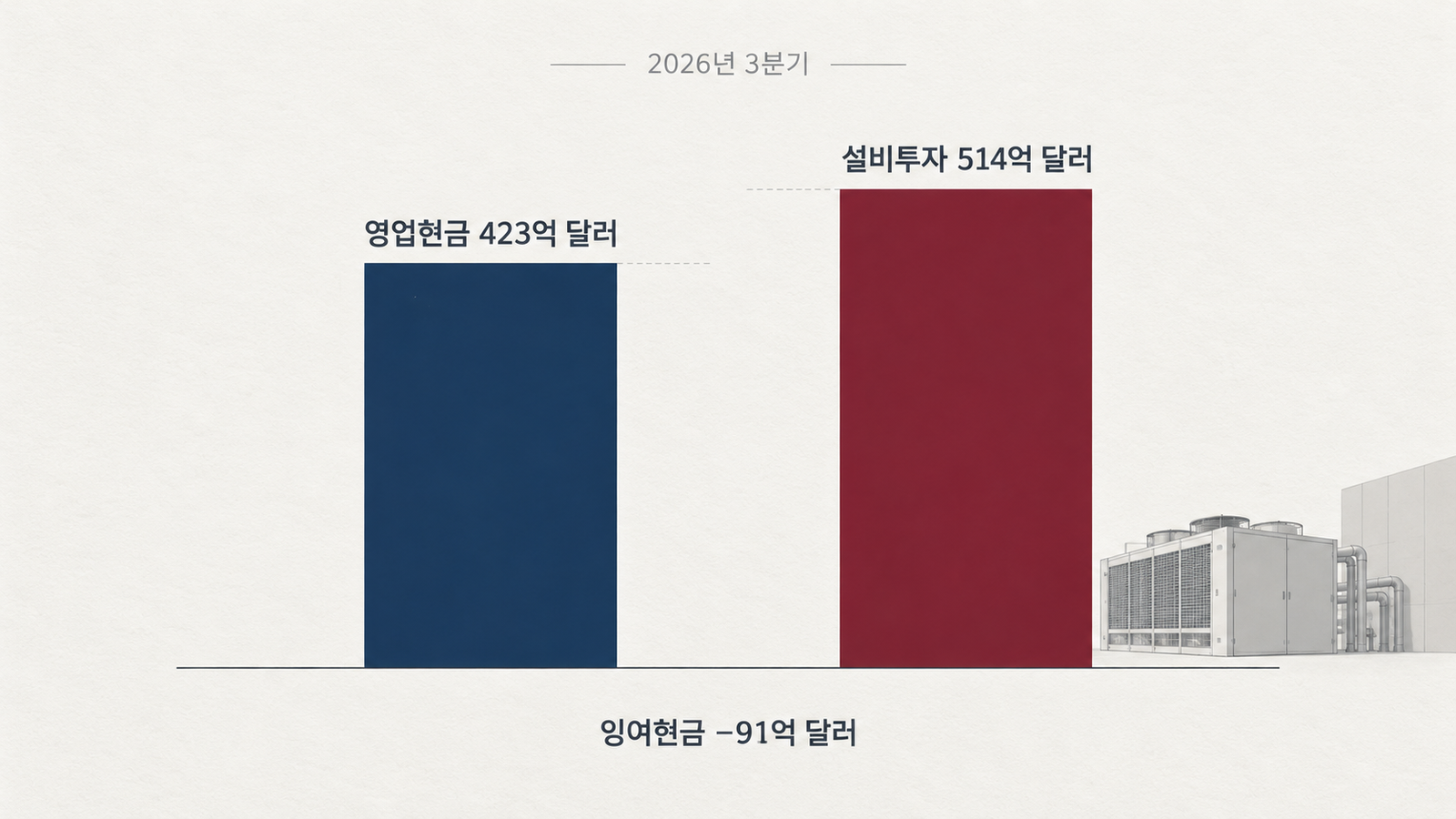
There's also a distinction to draw within the fact that operating cash itself fell from a year earlier. Management explained that a cash payment of roughly $5.2 billion for a European Commission fine and an inventory build to prepare for TPU system sales both affected operating cash flow.
This explanation argues for guarding against both extremes. This quarter's deficit shouldn't be read straight through as proof that the search business is collapsing. At the same time, it shouldn't be waved off as harmless just because of a one-time payment and inventory. Even simply adding the fine payment back, free cash flow this quarter would still be a deficit of about $3.9 billion, all else equal. That's not an adjusted figure the company reported — it's a simple calculation to size up the payment.
In the same disclosure, free cash flow for the trailing twelve months was a surplus of about $19.7 billion, but Q2 and Q3 recorded quarterly deficits in a row. One quarter's deficit can't be blown up into the whole of annual cash generation, but it does mean we should also watch whether the stretch in which investment runs ahead of cash is getting longer.
The TPU systems business in particular has a time lag built into the money. Management described a flow in which, once contracts are signed, components and inventory are secured, then systems are delivered and invoiced, and cash is collected. The risk that pre-built goods go unsold and the situation of spending money up front to fulfill contracts should be told apart. Even so, whether contracts actually turn into deliveries and collections needs to keep being verified.
In its public summary, Cyn Research separated the timing factors behind weaker operating cash from the burden of heavy capital expenditure. Carry that distinction into an investment decision and you end up separately checking whether the money first tied up in inventory comes back, and how much will keep flowing into equipment. Even if a quarter's cash improves once inventory is sold and collected, you can't assume the cash left over for shareholders recovers at the same pace if capex keeps expanding.
Search Profits and Cloud Profits Can't Simply Be Swapped for Each Other
Couldn't cloud just grow by more than search softens? In direction alone, it's a plausible story. But the arithmetic of trading an existing revenue base for a new business's growth rate is more complicated than it seems.
Google Services — the segment that includes Search, YouTube, and other businesses — generated Q3 operating income of about $39.2 billion. However fast cloud has grown, the existing services business remains a large profit base. At the same time, this number is not search-only operating income. The company's segment disclosures shouldn't be reinterpreted as search's standalone profit or cash flow.
Cloud operating income deserves the same care. That the segment earns a profit matters, but that profit is not the same as the cash remaining for shareholders after capital expenditure. Company-level shared AI R&D costs are incurred separately as well.
This makes Google's inflection point sharper. While search's new experience has to protect existing advertising profitability, cloud has to recover the capital deployed up front as sufficient profit and cash. Revenue growth on either side alone makes it hard to claim both tasks are solved.
The Stock May Wait for Cash More Than for Revenue
Building conviction in a business by watching fast growth and deciding at what price to buy its shares are separate judgments. A quarterly free-cash-flow deficit alone doesn't mean the value has disappeared, but neither can you assume the old cash-generating power will return promptly just because all investment is temporary.
What matters is the character of the investment. Whether capacity is being built ahead of new customers, or has to be continually replaced to support expanded services, changes the cash that remains later. Alongside revenue growth, you have to track subsequent depreciation, operating costs, and the pace of additional investment.
Management expects capital expenditure to increase significantly in 2027 and explained that the higher technology infrastructure investment will also pressure the income statement through depreciation and data center operating costs. When the money is spent, cash flow weakens first; once the equipment enters use, the costs are spread across several years in earnings. So even if the pace of capex growth slows later, you shouldn't assume margins will immediately get lighter.
Financing can't be kept out of this calculation either. Alphabet disclosed that in Q3 it raised about $12.4 billion through common stock issuance, with net proceeds from senior unsecured bond issuance of about $28.7 billion. You can't assume all of that money went into AI capital expenditure. Still, how the money needed for growth is raised — and the share of the burden existing shareholders carry in that process — belongs on the same checklist as the business's growth.
Near-term concern and long-term optimism aren't necessarily at odds. But the mere fact that the stock has come down doesn't mean a margin of safety has been created. If estimates of future cash flows have also fallen, fair value can fall with them. This article doesn't compute a target price, so I won't turn the judgment that this is a good business into a buy case at today's price.
In the end, valuing Google takes a cash-flow picture that connects the transition in both businesses, rather than slapping a high multiple on search's past profitability or leaning on cloud's growth rate alone. Asking how much cash will remain, repeatedly, even after current investment — and how long the wait for that cash will be — seems the more important approach.
Conclusion
It's hard to see Google as a company running to cloud because search has collapsed. Search is still growing, and cloud is already a business producing large revenue and profit. But those facts alone don't get you to the conclusion that the AI transition is a good deal for existing shareholders.
In core search, Google has to change the user experience while still delivering value to advertisers and charging enough for it. In cloud, growing demand has to be converted into post-investment cash rather than stopping at bookings and revenue. One is a matter of protecting and reshaping how money is made; the other is a matter of recovering the money spent up front for growth.
Google's real inflection point may not be the moment it changes its name from a search company to an AI company, but the moment its ability to get people using more AI carries through to an ability to leave more cash with shareholders. What I want to see in the next earnings report isn't only records for usage and cloud growth, but the gap between them actually narrowing.
References
1. Alphabet — Q3 2026 earnings release and financial statements, October 28, 2026
2. Alphabet — Q3 2026 earnings slides, October 28, 2026
3. Google — Sundar Pichai's remarks on Q3 2026 earnings
Disclaimer: This article is informational content summarizing disclosures, analysis, and the author's views; it is not a recommendation to buy or sell any particular stock.