When it comes to AI semiconductor investing, most people think of GPUs first. But when a fund that invests in AI sells part of its NVIDIA stake and buys AMD fresh, what was it seeing differently?
A trade like that appears in the Baron Technology ETF's Q2 2026 letter. The interesting part wasn't just "an alternative GPU to NVIDIA." Among the reasons the management team took a fresh look at AMD was the view that as AI agents multiply, the CPU's job grows bigger.
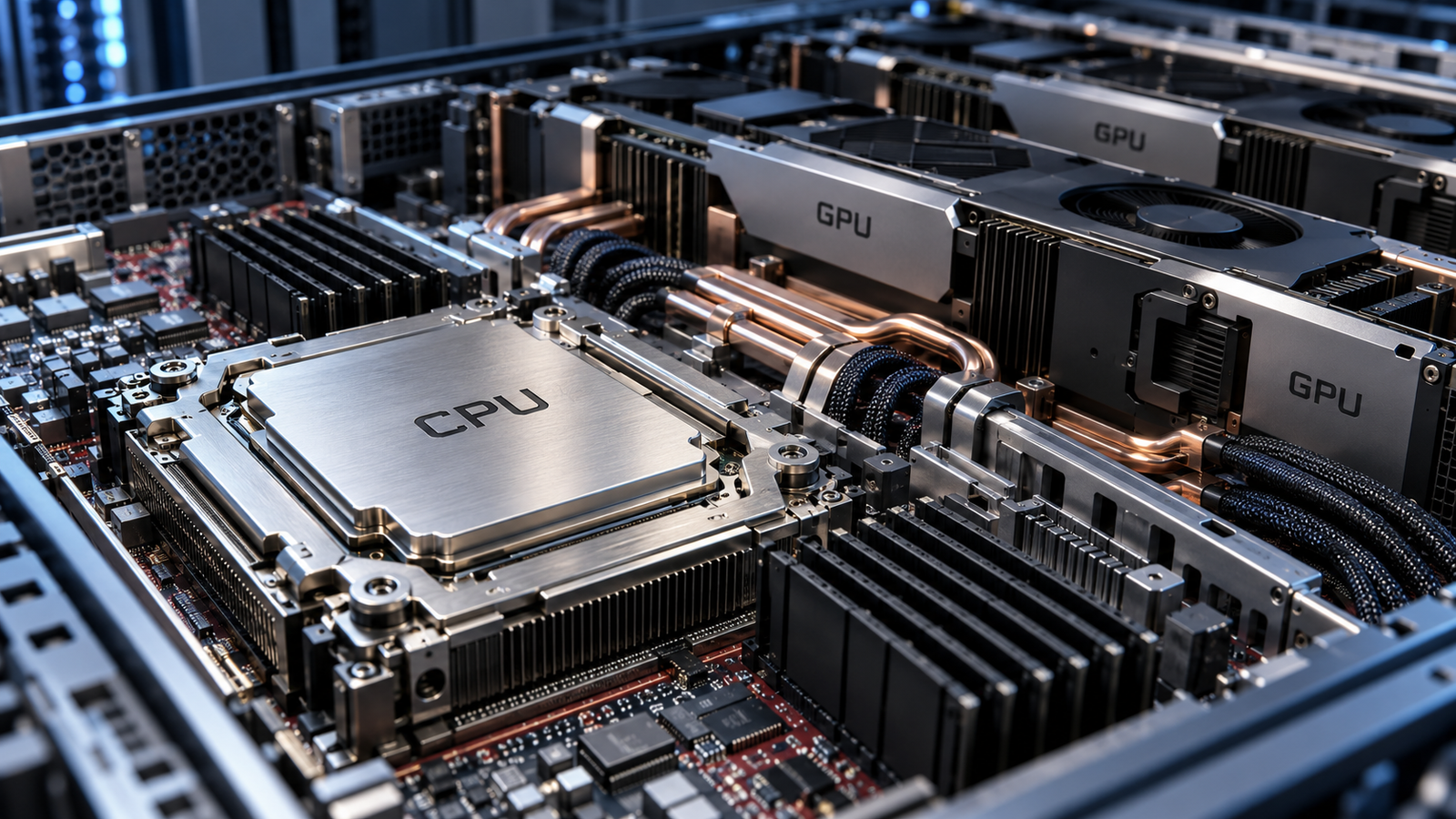
A conceptual image of a server in which a CPU and GPU work together; it is not the physical design of any specific AMD product. (* AI-generated image, ChatGPT·Codex Desktop)
They Didn't Buy AMD Because NVIDIA Was Wrong
First, it's worth clarifying the nature of the trade. The fund, run by Michael Lippert and Ashim Mehra, initiated a new position in AMD in Q2 with net purchases of $3.9 million. Over the same period, it net sold $7.5 million of NVIDIA.
Judging by those numbers alone, it looks like a bet on swapping the market leader. But the management team's explanation was different. They said NVIDIA's weight in the fund had simply grown too large, so they trimmed it, and their view of the company's long-term competitiveness was unchanged. In fact, as of June 30, NVIDIA still accounted for 5.6% of net assets.
So if you read this trade as "abandoning NVIDIA and jumping to AMD," you miss the important part. It is closer to a trade that kept the broad AI direction intact while widening the paths to make money within it. The gaze that had been fixed only on GPU growth shifted toward CPUs as well.
The GPU Does the Thinking, but Action Needs a CPU
Picture asking a chatbot one question and getting an answer. Attention concentrates on the computation the trained model performs to produce the answer — inference. That's why GPUs, which excel at massively parallel computation, take the spotlight.
But hand it a job like "find earnings data from several companies, compare them, run the calculations, and organize the result into a table," and the process gets longer. It has to search for data, read files, run code, and recheck when the results look wrong. It may also call the model several times along the way.
Beyond the model's computation, this requires a foundation that runs programs, moves data, and ties multiple tasks together. The CPU plays an important role in that execution environment and task orchestration. NVIDIA, too, describes agents' tool use, code execution, data processing, and coordination work as the territory its Vera CPU targets.
The Baron team zeroed in on exactly this: growing orchestration complexity. Their judgment is that as agents move across multiple models and enterprise systems, CPUs gain a broader growth opportunity than before.
Of course, it doesn't split cleanly into "GPUs think, CPUs execute." Models can run on CPUs too, and every service places computation differently. The point is not that GPUs become unnecessary, but that the work that needs to be handled around the GPU can grow as well.
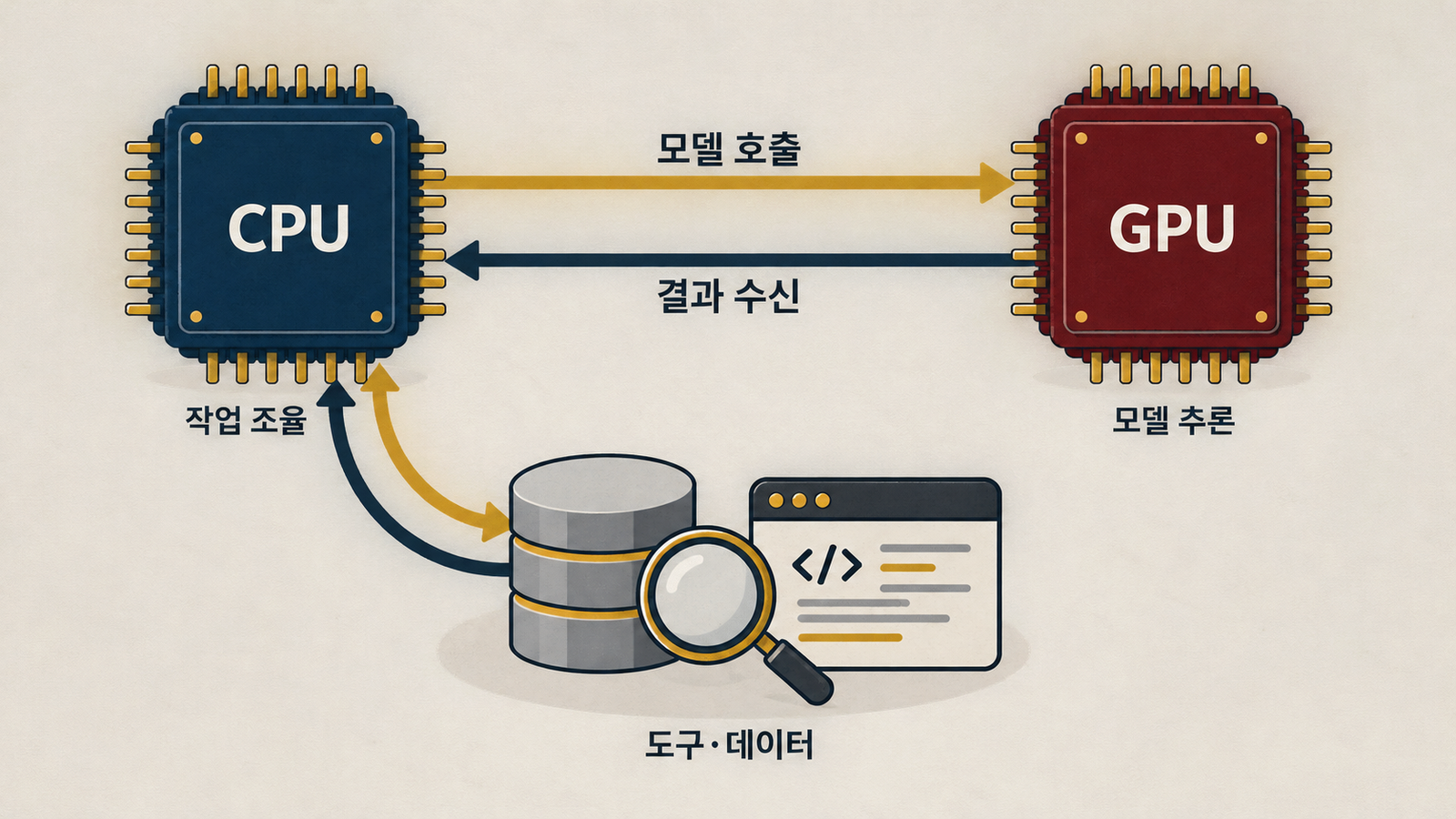
One example configuration of an agent using a GPU-based model. Actual implementations and compute placement may differ. (* AI-generated image, ChatGPT·Codex Desktop)
What the Meta Case Confirms — and What We Still Don't Know
This idea doesn't live only as a hypothesis inside the letter. In its October 27 announcement, AMD said its server CPU, EPYC, supports the dedicated computing environment behind Meta's personal AI agent, Muse.
This shows that the CPU is a real component of agent infrastructure. But the announcement doesn't explain all of AMD's future revenue. Meta is a customer that has already used multiple generations of EPYC. How different the new, agent-driven demand is from existing server demand — and how much revenue and profit Muse-related CPUs generate — were not separately disclosed in the announcement.
Investors need to go one step beyond "it's used in agents." They should watch whether, as usage grows, customers buy more CPUs, choose higher specifications, or simply get by using existing resources more efficiently. An increase in the work agents handle doesn't lift AMD's revenue by the same proportion.
The direction of recent results is clear. AMD's Q2 revenue, announced on August 4, was roughly $11.5 billion, up 50% year over year, while data center segment revenue was roughly $6.7 billion, up 107%. The company attributed the data center growth to demand for EPYC CPUs and Instinct GPUs.
One caveat matters here. Not all data center revenue is CPU revenue, and not all CPU revenue is agent demand. You can't take a large segment's growth rate and declare an entirely new investment thesis fully proven.
A Bigger CPU Market Won't Belong to AMD Alone
Even if you agree that the CPU's role is expanding, who collects the fruits is a separate question. When NVIDIA unveiled the Vera CPU as a product for agents on May 31, it laid out everything from standalone CPU servers to systems that combine CPU and GPU.
That is why a positive case for AMD doesn't translate directly into a negative case for NVIDIA. The more important CPUs become, the more aggressively NVIDIA can attack that market too. Baron's choice — keeping NVIDIA while buying AMD — may show the shape of this competition better than a trade premised on one side winning outright.
For customers, too, what matters isn't only the name on a chip. How quickly the same job gets done, how much electricity it uses, and how much it costs to migrate and operate existing software all feed into the purchase decision. For AMD to turn the CPU's new role into revenue, it has to win on the performance and costs customers actually feel.
Growth in a Great Business Isn't the Same as Great Earnings per Share
Next is the question of price and per-share earnings. The mere fact that Baron bought AMD in Q2 doesn't let you conclude that today's price is attractive. What you pay, relative to the growth you expect, remains the question.
Earnings also need a consistent yardstick. AMD's Q2 earnings per share were $1.38 under GAAP, the U.S. accounting standard, and $1.66 on a non-GAAP basis that adjusts for items such as stock-based compensation. A lower-looking P/E computed on adjusted earnings doesn't erase the costs that actual shareholders bear.
The same goes for contracts with major customers. AMD's Q2 10-Q discloses warrants granted to OpenAI and Meta — rights to acquire stock under set conditions — allowing each to purchase up to 160 million shares. The structure vests those rights in stages based on GPU purchases, the share price, and technical and commercial terms. As of June 27, no shares had yet vested or become exercisable.
It would be wrong to assume all of those shares are already outstanding, but it would be equally wrong to look at the size of the deal and assume existing shareholders' slice grows just as much. You need to watch together how revenue and gross profit grow and how the share count changes in the process.
In the end, judging the price requires a path to earnings per share that connects CPU growth rates, GPU business profitability, costs, and the share count. "CPUs also benefit from AI" is the starting point of an analysis, not an answer that does the math for you.
Conclusion
What's interesting about Baron's trade isn't a declaration that it found the next NVIDIA. It's the idea that as AI shifts from a tool that answers people's questions into an agent that completes work through multiple steps, the other components inside the computer deserve a second look.
AMD is both a challenger in the GPU race and a company that already owns a server CPU business. If the spread of agents adds work for CPUs, there's a reason to watch the two businesses together. Still, the fact that CPUs matter more does not, by itself, guarantee AMD's market share, profits, or stock price.
AMD is scheduled to report Q3 results after the U.S. market close on November 3. In that report card, as much as the size of its AI-related contracts, I want to see how much of the growing compute demand it is converting into actual revenue and earnings per share.
Perhaps Baron's move wasn't a trade that saw the end of the GPU era, but a trade that saw the next stage of AI — one that won't end with GPUs alone.
References
2. Baron Technology ETF fact sheet — holdings weights and management team as of June 30, 2026
3. AMD–Meta partnership announcement — October 27, 2026
4. AMD Q2 2026 results — announced August 4, for the quarter ended June 27
5. NVIDIA Vera CPU announcement — May 31, 2026
6. AMD Q2 2026 10-Q — warrant and stock-based compensation disclosures, filed August 5
7. AMD Q3 earnings schedule — November 3, 2026, after the U.S. market close
Disclaimer: This post is informational content summarizing public disclosures, analysis, and the author's views; it is not a recommendation to buy or sell any particular stock.