Intel said in its earnings report that “CPU demand is strong.” Yet in the same report, fourth-quarter revenue guidance came in below the current quarter's, and a sizable portion of net income came not from operating results but from accounting valuation gains. Let's calmly unpack what stands between a company that makes money and a company where shareholder value actually builds, starting with the Q3 2026 earnings materials.
Demand Really Is Strong
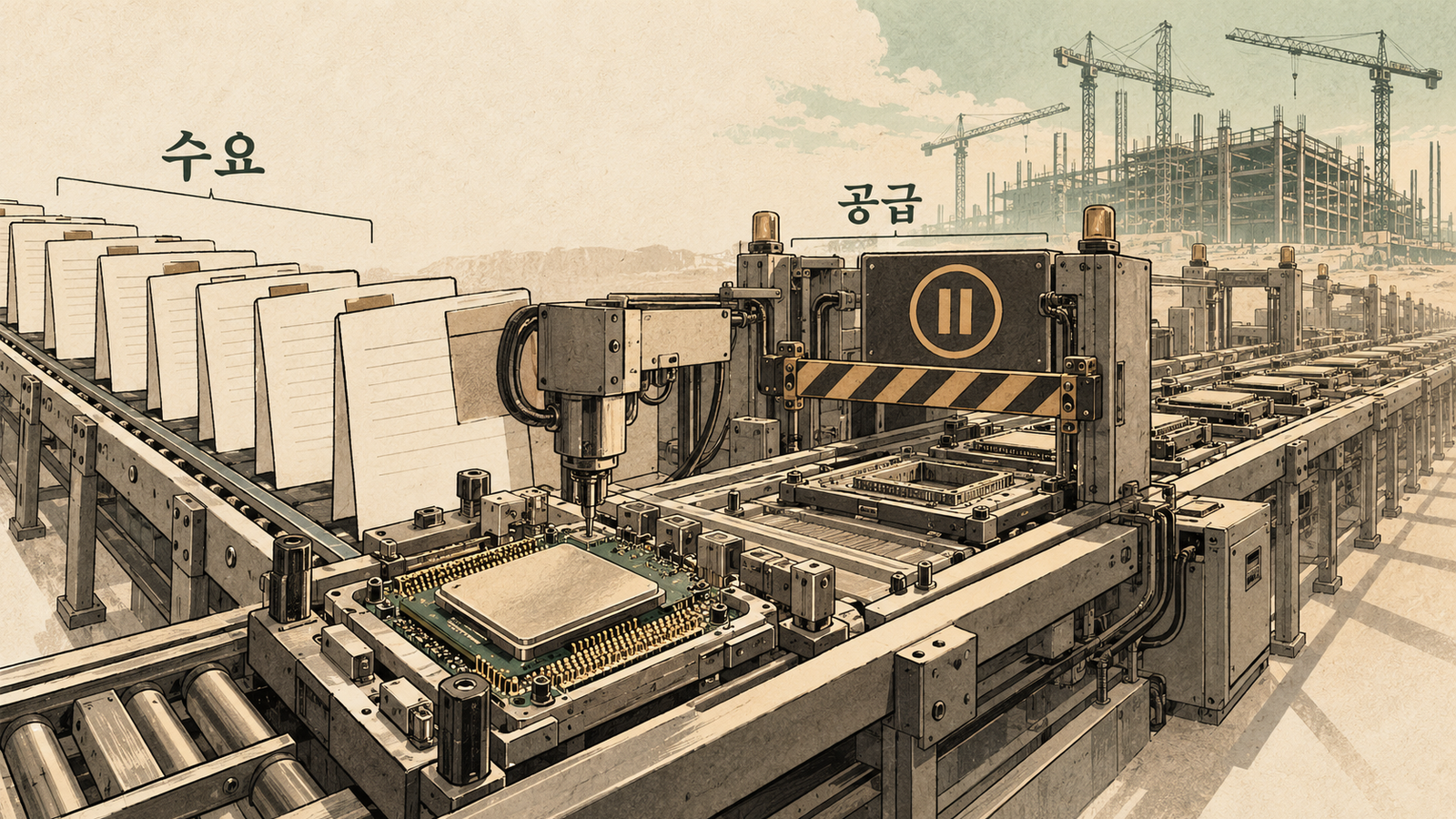
Intel reported third-quarter 2026 results on October 29, with revenue of $16.5 billion, up 21% from the same quarter a year earlier. Against the year-ago quarter's $13.7 billion, that is a meaningful rebound in quarterly revenue. The growth was driven by the Data Center and AI segment (DCAI), which grew 78% year over year to $7.3 billion. In the same report, CEO Lip-Bu Tan said “CPU demand remains strong” and identified supply, not demand, as the immediate challenge, and CFO David Zinsner added that these results marked the strongest data center revenue growth in 15 years.
If you remember the AMD story this blog covered last month, the picture fits together. The view that the AI boom's benefits don't flow only to GPUs is gaining force both in the stock market and on actual data center construction sites. As AI services scale, general-purpose server CPUs that receive and carry the traffic are needed alongside the accelerators that run the models. The numbers in Intel's filings show exactly that flow.
But a bigger cake doesn't mean the incremental slice goes to Intel. The market still largely frames the server CPU race as a story of “taking share from Intel,” and the same analysis noted that AMD management has sketched a picture in which the server CPU market could grow more than eightfold within five years. Even if industry-wide demand grows, if a competitor takes the increase, the strong demand Intel is feeling does not flow straight into per-share value for Intel shareholders. The strength of demand and a company's competitive position are separate questions.
That said, in the same release the CFO said PC demand weakness is expected to continue “through the first half of next year.” In fact, revenue at the PC-centric CCPG segment was $8.1 billion, down 5% from a year earlier. The hotter servers run, the colder laptops get — Intel is effectively holding two diverging ledgers inside one company.
But Look Inside the Net Income
Third-quarter GAAP net income was $3.3 billion, with earnings per share (EPS) of $0.60. Yet the non-GAAP EPS the company reported was $0.52 — actually lower. On the surface, “GAAP earnings being the larger number” reads like a good thing, but open the reconciliation table in the filing and the story changes. Inside that $3.3 billion of GAAP net income are roughly $1 billion ($0.17 per share) of mark-to-market gains on 5 million shares held in escrow in connection with the Secure Enclave contract with the U.S. government, plus $330 million ($0.06 per share) of valuation gains on equity investments — both of which the company strips out of its non-GAAP results. In other words, the profit coming from operations itself is thinner than it looks, and a substantial part of the headline number is valuation gains far removed from the business.
What those escrowed shares actually are is spelled out in the 10-K's term definitions and in the 10-Q. They are shares Intel agreed to hand to the U.S. Department of Commerce under the CHIPS Act: if conditions are met, a portion is transferred to the government; of the shares that are not, half is returned for no consideration and the other half is retired. The carrying value of this derivative liability grew from $2.7 billion at the end of 2025 to $13.7 billion as of the end of Q3 2026. A structure that hands over stock in exchange for subsidies remains, from a shareholder's standpoint, a standing dilution factor that works much like continuous new share issuance.
The dilution already shows up in the numbers. Third-quarter diluted share count was 5.307 billion shares, up 17% from 4.531 billion in the same quarter a year earlier. For any given profit, a larger denominator thins per-share value by that much. On top of that, Intel disclosed in this earnings release that it completed a $23 billion public offering to fund growth. When a company's share count keeps swelling behind a rebounding revenue line, investors like me are better off judging it per share rather than by revenue.
Why the Foundry Segment Posts Losses, Not Profits
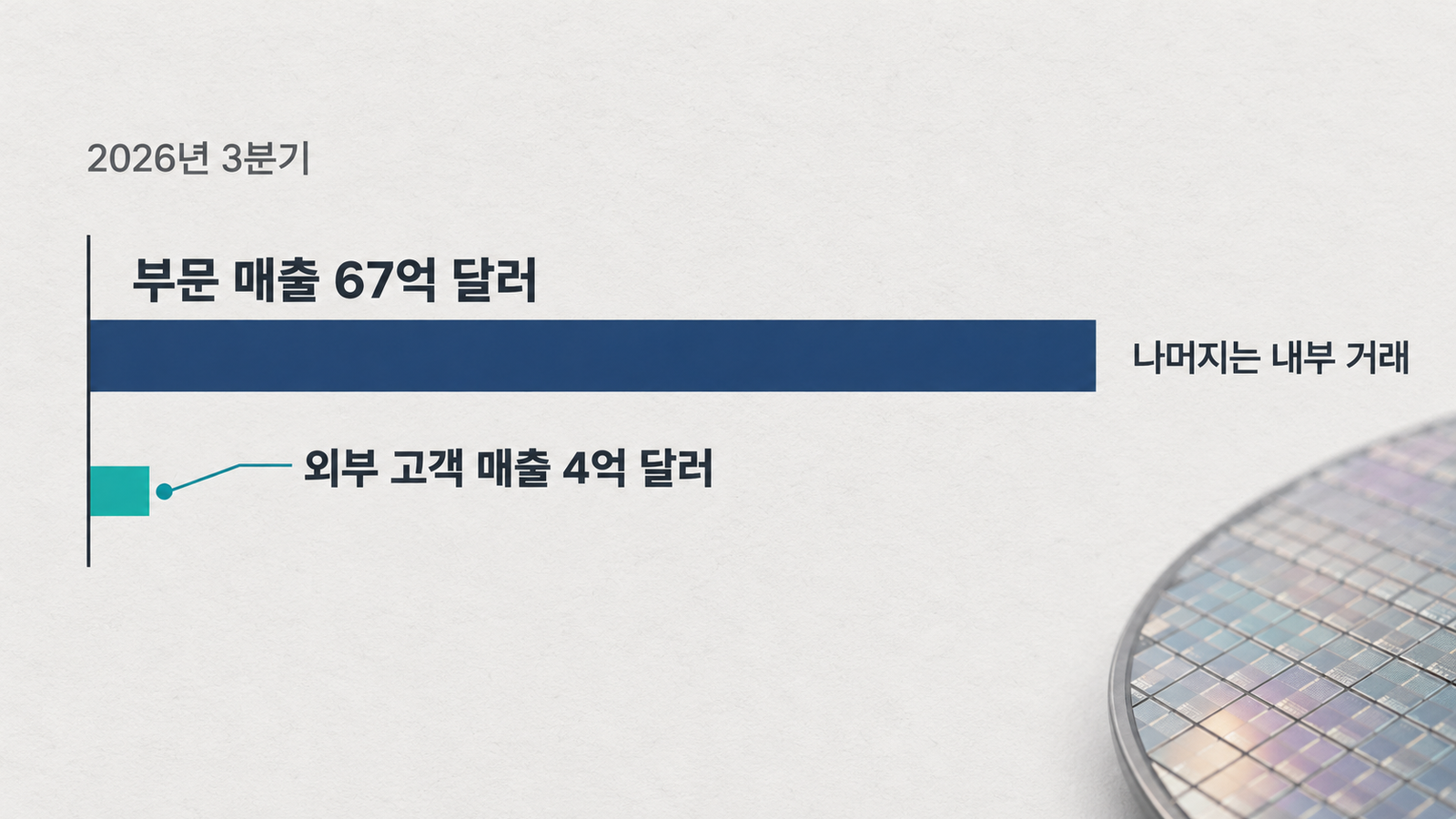
The segment results in the 10-Q sting. The foundry segment booked $6.7 billion of Q3 revenue but an operating loss of $1.85 billion, bringing its cumulative operating loss for the first nine months of the year to $6.4 billion. In the same table, DCAI posted $3.0 billion of operating income on $7.3 billion of revenue, and CCPG $2.3 billion of operating income on $8.1 billion of revenue. The pattern of product segments earning what the foundry loses repeats every quarter.
A common misunderstanding arises here. Most of the foundry segment's $6.7 billion in revenue is internal — sales to Intel's own product segments. Per the 10-Q, foundry revenue actually billed to external customers was $411 million in Q3, only about 6% of segment revenue. External revenue growing from $32 million in the year-ago quarter to nearly 13 times that in a year is unmistakable progress, but reading “$6.7 billion in foundry revenue” as external customer revenue overstates the scale several times over. In the consolidated financial statements, nearly $6.3 billion of intersegment revenue is eliminated as a reconciling item, leaving total company revenue of $16.5 billion.
There are, on their own, signals that the foundry is improving. This quarter the company released a new process design kit for Intel 14A and announced a High-NA EUV equipment ecosystem collaboration with ASML and a packaging partnership with Lens Technology. But it takes time for process kits and customer contracts to climb to breakeven, and the $6.4 billion of losses stacking up over nine months in the meantime is, in the end, a cost shareholders bear.
Progress and Profitability Move Separately
The cash the company generated confirms the improvement is real. Third-quarter operating cash flow was $5.1 billion, more than double the $2.5 billion of the same quarter a year earlier. The company-defined adjusted free cash flow also grew from $896 million into the $1.6 billion range. The problem is that cash goes out faster than it comes in. In the same quarter, $4.2 billion went out as capital expenditures, investing cash flow showed a $19.6 billion outflow, and financing activities took in $23.3 billion including offering proceeds — the company is still at a stage where building the industry requires outside capital.
Guidance is also pivotal. Intel guided fourth-quarter revenue to $15.0–$16.0 billion, a range centered below this quarter's $16.5 billion. GAAP gross margin is set to fall from 43.0% this quarter to 37.1% in the fourth, and the GAAP EPS forecast drops sharply to $0.10. The next scene the company is drawing for itself is closer to “keep investing while earning a bit less” than to “earn more and invest more.” With the PC slowdown already expected, how far server demand fills that gap remains a question to check every quarter.
Conclusion
The claim that CPU demand is strong is fact, confirmed by the filed numbers. Twenty-one percent revenue growth, data center revenue up 78%, operating cash flow doubled — up to that point, this is a rebound. But the reason Intel's problems won't end lies in the layer beneath. The foundry is still losing more than $1.8 billion a quarter, and because most of its revenue is internal, its scale is not one the external market has validated. The part of net income that swelled came from valuation gains rather than operations, the share count has grown 17% in a year, and the $23 billion public offering raised from outside the business keeps enlarging the denominator of per-share value. The revenue rebound is complete; the fabs and the capital structure needed to turn that rebound into per-share earnings are not yet in order. If Intel can hold strong demand long enough, time can side with it. But I believe the investment question in this company becomes accurate only when you also see that today's shareholders are splitting the cost of buying that time.
Disclaimer: This post is informational content summarizing public filings, analysis, and the author's views; it is not a buy or sell recommendation for any particular stock.