Bill Ackman's Pershing Square bought Amazon when its stock price was shaken by the tariff shock in April, and a year and a half later, it remains one of their largest positions. In the meantime, however, an unfamiliar sight has unfolded across Amazon's financial statements. Operating cash flow swelled to an all-time high, but capital expenditures exceeded even that, leaving trailing-12-month free cash flow at negative $42.4 billion. It's as if, within a single company, one engine earns money while another burns it — and Ackman's bet is precisely that these two engines will eventually converge into a single cash stream. Let's unpack whether AWS's explosive growth is indeed justifying the massive investment costs, using Q3 results and financial statements step by step.

The Balance That Vanished in April's Panic
Pershing Square disclosed that it built its current Amazon position starting April 21, 2025, and notes that the forward 12-month P/E ratio (price divided by expected earnings over the following year) at that point was 25.4x. The entire market was shaken after Trump's "Liberation Day" tariff announcement in February 2025, and Amazon — which combined in one entity a logistics-dependent retail operation that seemed most vulnerable to tariffs and a cloud business burdened by AI investment concerns — was hit particularly hard. The average purchase price at the time of disclosure was recorded at $178.
Over the course of 2025, Amazon contributed 2.4 percentage points to Pershing Square's returns, and as of year-end 2025, 13% of capital was allocated to this position. What's interesting is the present. As of the end of August 2026, Amazon remains listed on the official fact sheet's holdings, and in the 2026 first-half performance report, Amazon was named the top contributor to first-half returns (+1.7 percentage points). For reference, on SEC 13F filings, Pershing Square Holdings held 11.45 million shares (approximately $2.385 billion, 17.4% of reported assets) as of the end of March 2026, but in August, the reporting obligation was transferred to the parent company, so quarterly snapshots after that have not yet been disclosed. It's also worth keeping in mind that 13F is merely a point-in-time photograph at quarter-end.
How AWS Is Making Money Right Now
The first axis the Ackman team zeroed in on at Amazon is AWS. In its February 2026 presentation, Pershing Square diagnosed that "even at a $140 billion annualized revenue run rate, AWS maintained 20% growth, but demand exceeded supply," and predicted that the plan to double data center capacity by 2027 would be rapidly absorbed by AI inference demand.
Q3 results show this prediction is still a work in progress. AWS revenue in Q3 2026 was $46 billion, up 39% year-over-year, the fastest pace in five years. Segment operating income was $17.8 billion, up 55%, bringing the segment margin to 38.7%, and CEO Andy Jassy indicated in the earnings call that he expects growth exceeding 40% in 2027 and 2028 as well. At this pace, AWS revenue already accounts for 20.2% of total revenue on a trailing-12-month basis, while AWS is generating 58.5% of trailing-12-month operating income.
Retail Is Widening Its Margins
The second axis is retail. In Q3, North America segment operating income was $8.7 billion, up 82% from $4.8 billion a year earlier, and the trailing-12-month North America margin rose to 8.2%. Even accounting for the distortion from Prime Day timing shifts, the company guided that advertising revenue would recover to mid-teens growth in Q4.
In its February materials, Pershing Square wrote that thanks to the increasing share of high-margin revenue such as advertising, logistics network density, and automation, retail profitability had the potential to nearly double structurally. It's important to note that this part is the investment team's estimate rather than an official company target. Indeed, the 2026 first-half report also repeats the team's view that retail segment sales volume recorded its fastest growth of 15% since 2021, and that they read this growth as sustainable margin expansion.
So Why Is Cash Flow Negative?
Everything up to this point sounds like pure tailwinds, but open the cash flow statement in the Q3 press release and the story flips. Trailing-12-month operating cash flow was $168.3 billion, up 29% year-over-year, but during the same period, property and equipment purchases reached $210.7 billion, leaving free cash flow at negative $42.4 billion. The company's defined free cash flow (operating cash flow minus net property and equipment purchases) was a positive $14.8 billion a year ago, but shrank by $57.1 billion in a single year. Amazon explicitly attributed the cause of this decline to "primarily artificial intelligence investment."
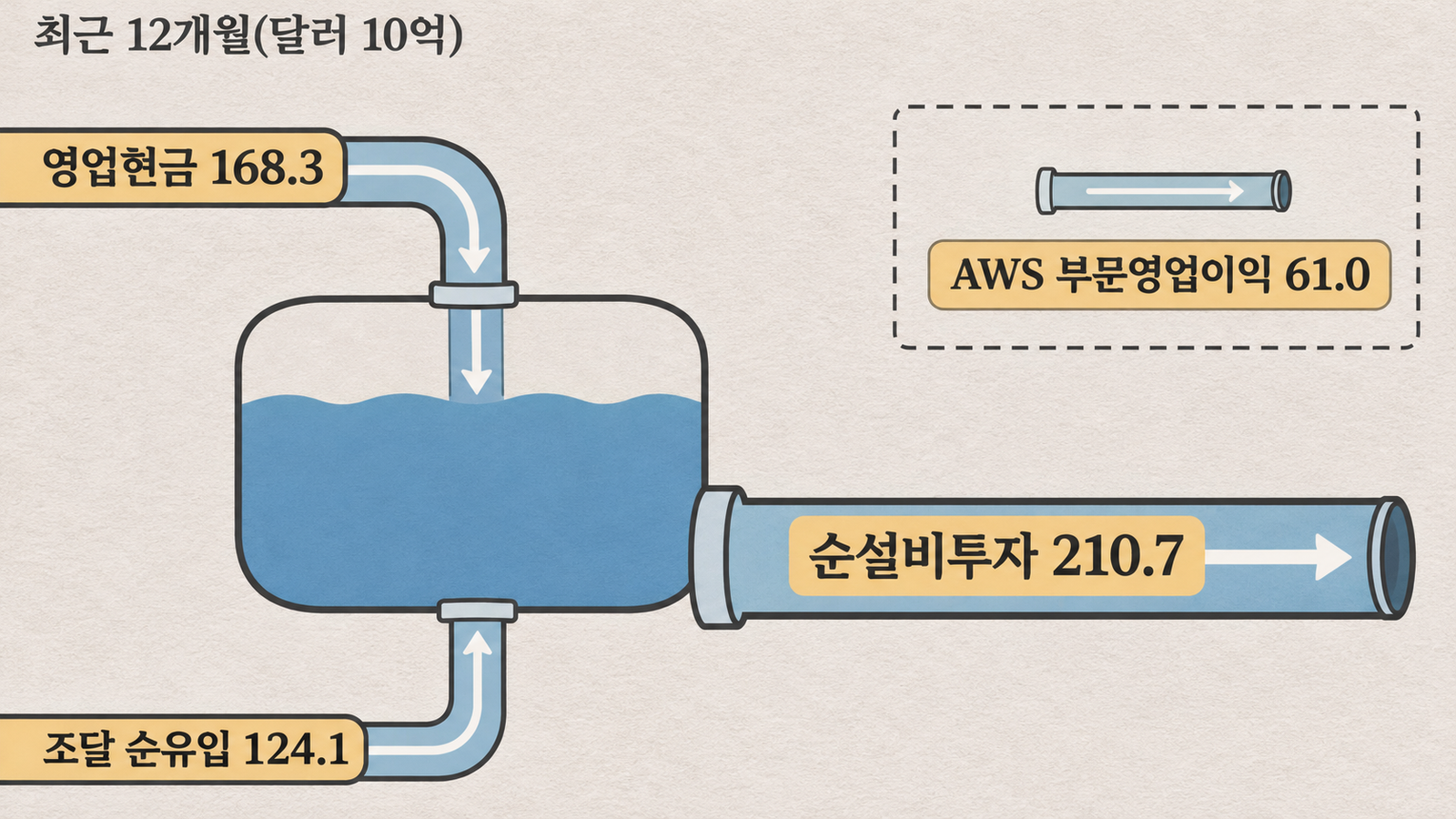
How was the shortfall covered? During the same period, financing cash flow recorded a net inflow of $124.1 billion, and on the balance sheet, long-term debt grew from $65.6 billion to $173.1 billion in one year. The company expects 2026 cash-based capital expenditures to be approximately $220 billion, which is 1.7x the total for 2025 (approximately $128.3 billion). Segment operating income and consolidated cash flow are separate accounting categories, so no matter how much AWS earns, that money doesn't directly fund data center construction costs. Even as AWS profits grow, while the company as a whole absorbs investment costs, the cash returned to shareholders shrinks — this is exactly that moment.
Does Ackman's Math Hold Up?
Pershing Square wrote in its first-half report that "concerns about the massive investment costs behind AWS data center construction are weighing on the stock price, but such concerns underestimate the resilience and growth potential of Amazon's business". Applying this perspective to Q3 numbers, there is a case to be made. AWS already generates the majority of consolidated operating income, its growth rate is actually accelerating, and retail margin expansion is running as a separate engine. As of June 30, 2026, the investment team's estimated 3–5 year EPS compound annual growth rate for Amazon was 24%.
On the other hand, the points where this math could break are also clear. If the $220 billion investment fails to meet actual demand and leaves empty data centers, only depreciation remains. AWS's 40% growth forecast is CEO Jassy's statement, not confirmed results. And Pershing Square itself recorded a negative return of 12.6% on a NAV basis in the first half, with the Amazon position itself contributing +3.1 percentage points to hold the line, so the investment team is surely feeling firsthand how much investment concerns are pressuring the stock.
Conclusion
The massive investment costs have not yet been justified — justification is still in progress. However, the pace of that progress is faster than expected, which is the key takeaway from the Q3 numbers. AWS growth accelerated to 39%, and margins outside AWS are structurally widening as well, so total company operating income grew 37% on a trailing-12-month basis. Recalling that Ackman bought at a forward P/E of 25x in April 2025, he bought undervaluation at the moment skepticism peaked — not growth — and the current negative free cash flow appears to be a phase that was part of the plan from the start. The moment when $220 billion in investment costs begins converting into future operating income rather than data centers — the moment when that conversion starts showing up in the cash flow statement rather than the balance sheet — that will be the decisive moment for this investment.
Disclaimer: This article is informational content summarizing public filings, analysis, and the author's views, and is not a buy or sell recommendation for any specific security.
References
- Pershing Square — Annual Investor Presentation (Feb. 11, 2026): https://assets.pershingsquareholdings.com/wp-content/uploads/2026/02/11144917/2026-Annual-Investor-Presentation.pdf
- Pershing Square Holdings — Interim Report June 30, 2026 (Aug. 2026 filing): https://assets.pershingsquareholdings.com/wp-content/uploads/2026/08/13002306/Pershing-Square-Holdings-Ltd.-June-2026-Interim.pdf
- Pershing Square Holdings — Fact Sheet August 31, 2026: https://assets.pershingsquareholdings.com/wp-content/uploads/2026/09/15151132/PSH-Fact-Sheet-August-2026-Website.pdf
- Amazon.com — Amazon.com Announces Third Quarter Results (Oct. 29, 2026): https://ir.aboutamazon.com/news-release/news-release-details/2026/Amazon-com-Announces-Third-Quarter-Results/
- SEC EDGAR — Pershing Square Holdings Ltd 13F-HR Q1 2026 (filed May 15, 2026): https://www.sec.gov/Archives/edgar/data/1336528/000117266126002336/infotable.xml