In the final week of October, the U.S. tech stock market saw a month-long correction accelerate into a sharp plunge. Alphabet, which reported earnings on October 28, saw its stock fall more than 12% the next day—its worst day since going public—and two days later, on October 30, Intel collapsed 28.6% in a single day, its worst day since the 1970s. That same day, the Nasdaq Composite fell 2.9%, its biggest drop since June, while the S&P 500 recorded its worst day since June with a 1.8% decline. Measured from its October 6 peak, the Nasdaq 100 had fallen more than 9% over the month, and some calculations put the evaporated market capitalization at around $5 trillion. Yet what the market focused on in this selloff was not weak earnings themselves. It was doubt about what kind of money is funding the spending being poured into AI infrastructure—and whether that money can be repaid.

The Order of the Collapse — Debt-Financed Builders Went First
What stands out in this correction is the sequence of the declines. The first to shake were the companies that build data centers themselves and run them on borrowed money. CoreWeave, a debt-dependent AI cloud provider, plunged 15.5% in a single day on October 14, and Nebius, cut from the same cloth, also posted a double-digit decline. For the month of October, CoreWeave fell 37% and Nebius nearly 35%; both companies run a business model of expanding data centers with debt and renting out AI computing capacity.
Next came the equipment sellers. In a single day on October 30, Nvidia fell 4.2%, AMD 10.9%, and Micron 5.3%, while SK Hynix's U.S.-listed depositary receipts dropped 7.95%. SanDisk, which had beaten earnings forecasts, sank 13.5% in a day, and server makers Dell and HP fell 10.8% and 9.6%, respectively. The benchmark semiconductor index dropped 7.2% that day, turning its October return to more than minus 15%, and the iShares semiconductor ETF was down 29% from its peak, entering a technical bear market. Among platform companies, Alphabet took the hardest hit, falling nearly 13% the day after its announcement.
Microsoft, which reported earnings that same week, by contrast posted 19% revenue growth and 21% operating income growth, and even with massive AI infrastructure spending it kept free cash flow positive, escaping the initial plunge. In other words, the dividing line for the selloff was not the size of the spending but whether a company could cover it with its own cash.
Earnings Weren't the Problem — Money Was
Alphabet's third-quarter results themselves were not bad. Revenue rose 25% year over year to $127.6 billion, Google Cloud revenue grew 103% to reach $30.7 billion, and search query growth was the highest in five years. The problem was the bottom line. EPS of $2.12 came in nearly 30% below the consensus of $3.02, with an $8.2 billion unrealized loss on its SpaceX stake playing a part. The heavier number was capital expenditure. Quarterly capex reached $51.4 billion, more than double the $24 billion a year earlier, and free cash flow was negative $9.07 billion—a second consecutive quarterly deficit.
Amazon was similar. It posted revenue of $201.9 billion and operating income of $28.1 billion for a record 13.9% margin, while AWS grew 39%—its fastest expansion in five years. But by keeping its capex plan of roughly $220 billion for this year intact, quarterly free cash flow was negative for the second straight quarter, and on a trailing twelve-month basis the deficit widened to negative $42.4 billion. In the same period a year earlier, it was a positive $14.8 billion. CEO Andy Jassy repeated the plan to spend "even more" next year.
Intel's decline was somewhat different in character. Its headline results beat expectations on both revenue and profit, but its fourth-quarter revenue guidance of $15–16 billion fell far short of the $17.1 billion consensus, and its adjusted EPS outlook of 25 cents also missed the 44-cent consensus. On top of weak PC market demand and the burden of rising memory prices, an explosion at its Israel plant was reflected as roughly $600 million of lost revenue spread over two quarters. It is a case of the paradox in which AI demand drives up component prices for PCs and smartphones and ends up undercutting demand in other markets—with the fallout showing up in earnings guidance.
The Financing Rush: The Bond Market Started Repricing First
Behind the selloff lies a change in financing structure. Until recently, the five hyperscalers issued around $35 billion in debt annually, but last year that rose to $93 billion, and this year it had already reached $132 billion by July. Including AI-adjacent sectors, this year's total issuance is estimated at $300–570 billion, and issuance of long-term bonds with 20–30 year maturities has become common.
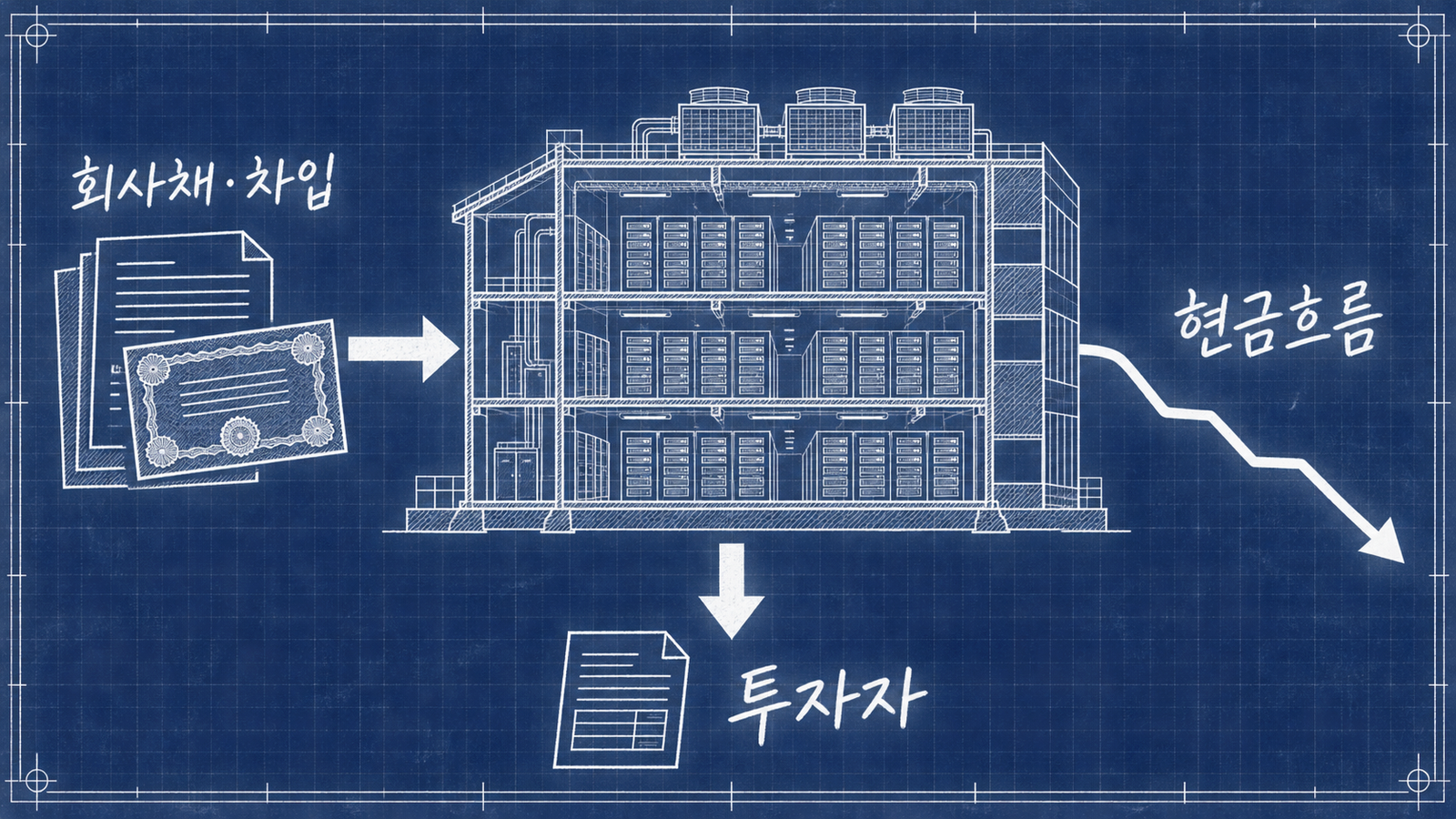
Oracle is the emblematic case. On November 2, Oracle raised $10 billion in stock and $10 billion in bonds—a total of $20 billion—to fund its AI infrastructure expansion. The problem was timing. Just five days earlier, Oracle had promised to scale back its fundraising, and with this raise, the entire 11% gain that followed its investor presentation was wiped out. Oracle's stock was already down 33% in 2026 and more than 50% over the past year, the yield on its 2031-maturity investment-grade bonds had risen to 7.276%, and the five-year credit default swap spread widened 265% in a year to 292 basis points. As of the end of August, its debt stood at $125.3 billion—about twice its equity—and the yield on its 2066-maturity bond was around 8.4%, a wide gap from Apple's and Microsoft's 6.1%. CoreWeave, the debt-laden AI cloud provider, is paying borrowing costs above 14%.
The financing rush is not Oracle's alone. The same day, Meta said it was considering a bond issuance of more than $20 billion across multiple currencies, Alphabet made its second eurobond issuance of the year, and Microsoft also issued $25 billion of corporate bonds on October 29. Under one asset manager's scenario calculation, if Amazon, Meta, and Microsoft fund even 30% of this year's capex guidance with debt, incremental issuance from these three alone would exceed $150 billion—a 24% increase over the previous year. The credit market has already responded. Market participants read the widening of AI-related bond spreads not as a product of the interest rate environment but as a repricing of hyperscaler credit fundamentals.
The next test of the AI ecosystem's demand for capital comes soon. Anthropic filed an S-1 for a Nasdaq listing on October 26, and the actual listing looks possible from the week of November 16. The company disclosed first-half revenue of $16.3 billion against a net loss of $80.7 billion, most of which stemmed from the accounting treatment of financing-related notes. There are also reports that the market's view of AI company credit grew colder after Blackstone published an analysis saying Anthropic's credit rating would struggle to remain at investment grade even after the IPO. On the other hand, there is a counterargument that the rating agencies are still showing patience, as illustrated by Fitch maintaining Oracle's BBB rating and stating that it expects no further large-scale fundraising after this round.
Conclusion
This selloff is not the end of demand for AI—it is the market's response to beginning to reread the accounting ledgers behind AI spending. The market is punishing three things in particular. First, the share of debt. The stock trajectories and borrowing-cost gaps between Microsoft, which builds with its own cash, and CoreWeave and Oracle, which build with borrowed money, draw that dividing line. Second, the sign of the cash flow. In an autumn when Alphabet, Meta, and Amazon all recorded negative quarterly free cash flow, only Microsoft, which kept it positive, survived—a benchmark that will be rechecked every quarter going forward. Third, the maturity structure. Having taken on today's technological uncertainty with 20–30 year bonds, the bond market's spreads are delivering their verdict ahead of the stock market. Anthropic's listing, fourth-quarter earnings, and AI-related bond yields will be this fall's follow-up rulings, and the distinction between companies that fund their spending with cash rather than debt will only grow more important.
Disclaimer: This post is informational content summarizing regulatory filings, analysis, and the author's views; it is not a recommendation to buy or sell any specific stock.
References
- Reuters — Wall Street closes sharply lower as AI cash burn fears spark tech selloff (October 30, 2026): https://www.reuters.com/5f374b32b07b/business/nasdaq-futures-tumble-amazon-intel-results-deepen-ai-spending-woes-2026-10-30/
- CNBC — Amazon, Intel shares fall after earnings amid AI spending concerns (October 30, 2026): https://www.cnbc.com/2026/10/30/amazon-intel-earnings-big-tech-ai-spending-concerns.html
- CNBC — Oracle files to sell $20 billion in new stock, bonds to finance AI buildout (November 2, 2026): https://www.cnbc.com/2026/11/02/oracle-files-to-sell-20-billion-in-new-stock-bonds-to-finance-ai-buildout.html
- Yahoo Finance — Oracle stock slides as it borrows another $10 billion for AI spending (November 2, 2026): https://finance.yahoo.com/markets/article/oracle-stock-slides-as-it-borrows-another-10-billion-for-ai-spending-184518137.html
- Bloomberg — Oracle Launches $10 Billion Sale of US Investment Grade Bonds (November 2, 2026): https://www.bloomberg.com/news/articles/2026-11-02/oracle-is-offering-10-billion-of-high-grade-dollar-bonds
- Reuters — Oracle taps investors for $20 billion to finance AI expansion (November 2, 2026): https://www.reuters.com/business/oracle-offer-10-billion-bonds-2026-11-02/
- MoneyWeek — Tech selloff: are AI spending concerns justified? (November 2, 2026): https://moneyweek.com/investments/tech-stocks/tech-selloff-ai-spending-concerns
- Global Systems Lab — The October 2026 tech sell-off (October–November 2026): https://globalsystemslab.com/transmission/tech-selloff-october-2026
- Investing.com — Alphabet Q3 2026 slides: $128B revenue overshadowed by profit miss (October 28, 2026): https://investing.com/news/company-news/alphabet-q3-2026-slides-128b-revenue-overshadowed-by-profit-miss-93CH-4981067
- Quartz — Google stock has its worst day ever after earnings miss raises AI fears (October 29, 2026): https://qz.com/google-stock-worst-day-ever-earnings-miss-ai-102926
- IBTimes — Amazon and Intel Plunge After Disappointing Results (October 30, 2026): https://www.ibtimes.com/amazon-intel-shares-fall-ai-spending-pc-market-3809185
- Financial News — New York Stocks: Tech stocks dumped on 'Bloody Friday' (October 31, 2026): https://en.fnnews.com/news/202610310527573578
- AI-CIO — How AI Debt Issuance Is Reshaping the Corporate Bond Market (2026): https://www.ai-cio.com/news/how-ai-debt-issuance-is-reshaping-the-corporate-bond-market/
- Mawer — Hey Google, how much can I borrow before I break the bond market? (November 2026): https://www.mawer.com/the-art-of-boring/blog/hey-google-how-much-can-i-borrow-before-i-break-the-bond-market
- Anthropic — Anthropic files S-1 with the SEC (October 26, 2026): https://www.anthropic.com/news/s1-sec
- The Verge — Anthropic files for its IPO (October 2026): https://www.theverge.com/ai-artificial-intelligence/1018476/anthropic-ipo-details-s1-filed-sec
- Business Insider — Stock Market Today: Nasdaq Plunges After Grim Intel, Amazon Earnings (October 30, 2026): https://www.businessinsider.com/stock-market-today-nasdaq-amazon-intel-q3-earnings-2026-10
- CNBC — AI stocks sell off as investors question AI spending returns (October 30, 2026): https://www.cnbc.com/2026/10/30/ai-stocks-selloff-ai-spending-returns.html